
Church History
Constantinianism (1) Councils and Synods (27) Early Church (23) Medieval Church (20) Renaissance and Humanism (1)
After Darkness, Light
The story of Geneva’s motto, Post Tenebras Lux, and how the recovered gospel brought the light of Christ out of medieval darkness.
Stewards of History
A call to steward church history as a living testimony to God’s providence, learning from the past to strengthen conviction and faithfulness in the present.
Constantinianism
Constantinianism
How Constantine’s alliance of church and empire transformed Christianity and introduced enduring confusion between the authority of church and state.
Councils and Synods
Councils and Synods
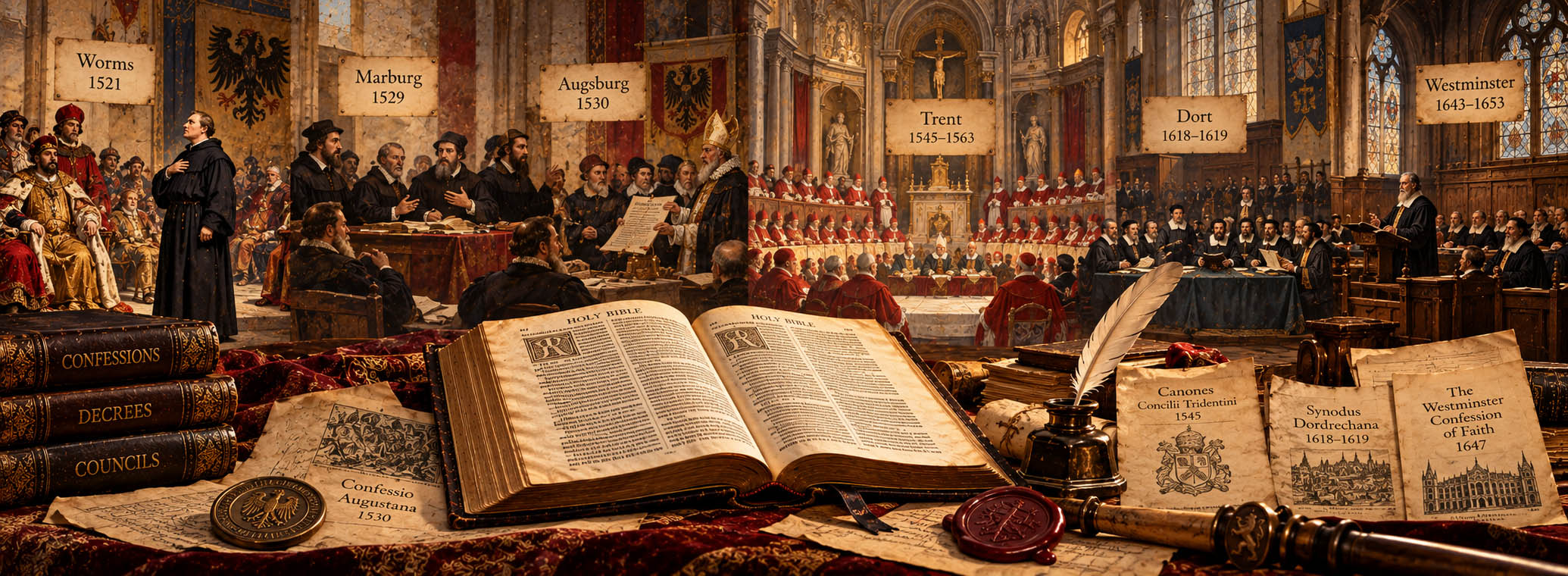
Explore the councils, diets, colloquies, and synods that shaped the Protestant Reformation, arranged in chronological order.
Disputations
A chronological guide to major public theological disputations that shaped the Protestant Reformation from 1518 to 1554.
Reformation-Era Councils and Diets
Baden Disputation (1526)
Baden Disputation (1526): The Swiss divide becomes public. A concise account of the debate and its place in the Protestant Reformation.
Bern Disputation (1528)
Bern Disputation (1528): The Word and a city’s decision. A concise account of the debate and its place in the Protestant Reformation.
Dispute de Rive (1535)
Dispute de Rive (1535): Geneva before Calvin. A concise account of the debate and its place in the Protestant Reformation.
Flensburg Disputation (1529)
Flensburg Disputation (1529): A contest over the Lord’s Supper. A concise account of the debate and its place in the Protestant Reformation.
Heidelberg Disputation (1518)
Heidelberg Disputation (1518): Luther’s theology of the cross. A concise account of the debate and its place in the Protestant Reformation.
Ilanz Disputation (1526)
Ilanz Disputation (1526): A parish’s freedom to choose. A concise account of the debate and its place in the Protestant Reformation.
Lausanne Disputation (1536)
Lausanne Disputation (1536): Reform in the Pays de Vaud. A concise account of the debate and its place in the Protestant Reformation.
Leipzig Disputation (1519)
Leipzig Disputation (1519): Luther and Eck debate papal authority, councils, and Scripture.
Locarno Disputation (1549)
Locarno Disputation (1549): A congregation under pressure. A concise account of the debate and its place in the Protestant Reformation.
Münster Disputation (1533)
Münster Disputation (1533): The struggle over baptism. A concise account of the debate and its place in the Protestant Reformation.
Oldersum Colloquy (1526)
Oldersum Colloquy (1526): A printed debate in East Frisia. A concise account of the debate and its place in the Protestant Reformation.
Oxford Disputations (1554)
Oxford Disputations (1554): Conscience under Mary I. A concise account of the debate and its place in the Protestant Reformation.
Oxford Eucharistic Disputation (1549)
Oxford Eucharistic Disputation (1549): The Lord’s Supper in Edwardian England. A concise account of the debate and its place in the Protestant Reformation.
The Colloquy of Marburg
The Colloquy of Marburg, 1529: Philip of Hesse's attempt to unite Luther and Zwingli, the fifteen Marburg Articles, the one point they could not sign together, and why the division over the Lord's Supper still matters.
The Colloquy of Regensburg
The Colloquy of Regensburg (1541): Charles V’s attempt to reunite Protestants and Catholics, the agreed article on justification, the break over the church and the Mass, and Calvin’s warning against a “half-Christ.”
The Council of Geneva
The Council of Geneva of 1536: the Dispute de Rive, the suspension of the mass, and the vote of 21 May 1536 by which the citizens of Geneva swore to live according to the Gospel and the Word of God — two months before Calvin arrived.
The Diet of Augsburg
The Diet of Augsburg of 1530: why Charles V called it, the three confessions submitted to him, the Confutation, the Recess of 19 November and its ultimatum, and the Schmalkaldic League that answered it.
The Diet of Worms
The Diet of Worms, 1521: Luther before Charles V, drawn chiefly from Roland Bainton's Here I Stand — the two hearings, the request for a day's delay, the answer of 18 April, the committee that nearly broke him, and the Edict passed by a rump.
The Diets of Speyer
The Diets of Speyer (1526 and 1529): the Word of the Lord endures forever, the recess that let each state answer to God, the Protestation that named the Protestants, and Calvin’s plea at Speyer in 1544.
The Zurich Disputations
The Zurich Disputations of 1523: Zwingli's Sixty-Seven Articles, the first Reformed confession; a city council that made Scripture the judge; and the question from Conrad Grebel that split the Reformation in two.
Zürich Baptism Disputations (1525)
Zürich Baptism Disputations (1525): The fracture over baptism. A concise account of the debate and its place in the Protestant Reformation.
Zürich Disputations (1523)
Zürich Disputations (1523): Scripture before the city council. A concise account of the debate and its place in the Protestant Reformation.
Synods and Assemblies
The Synod of Dordrecht
The National Synod of Dordrecht of 1578: the first national synod of the Dutch Reformed churches held on Dutch soil, its church order, its stand on the crown rights of Christ, and its concession to the magistrate.
The Synod of Dort
The Synod of Dort, 1618-1619: the Arminian Remonstrance that occasioned it, the international assembly that answered it, the God-centered theology of the Canons, its historical legacy, and conservative Reformed resources for study.
The Westminster Assembly
The Westminster Assembly, 1643 to 1653: called by the Long Parliament in the middle of a civil war, 1,163 sessions in the Jerusalem Chamber, four contending parties, and the standards that failed in England and governed Presbyterianism everywhere else.
Early Church
The Church Fathers
Short sketches of the major church fathers from Clement of Rome to Leo the Great, and their contributions to Roman Catholic and Reformation theology.
The Word “Catholic”
The origin and meaning of the word catholic, its association with the universal church, and its changing use under the Roman imperial church.
Church Fathers
Ambrose of Milan
The governor turned bishop whose preaching drew Augustine to Christ, who humbled an emperor, and who taught the West to sing.
Athanasius
The bishop of Alexandria, exiled five times, who stood against the world for the full deity of Christ.
Augustine of Hippo
The most influential theologian of the early church, whose doctrine of grace was claimed by both Rome and the Reformers.
Basil the Great
The leader of the Cappadocian Fathers, defender of the Trinity, “theologian of the Holy Spirit,” and father of Eastern monasticism.
Clement of Alexandria
The Alexandrian teacher who called philosophy the handmaiden of theology and taught the young Origen.
Clement of Rome
The Roman pastor whose letter to the Corinthians is the earliest Christian writing after the New Testament.
Cyprian of Carthage
The bishop of Carthage who taught that there is no salvation outside the church and made the bishop the center of its unity.
Eusebius of Caesarea
The father of church history, whose Ecclesiastical History is the chief source for the church from the apostles to Constantine.
Gregory of Nazianzus
The Cappadocian “theologian” who defended the Trinity and taught that what Christ did not assume he did not heal.
Gregory of Nyssa
The philosophical Cappadocian, brother of Basil, who made Scripture the umpire against the Arians and helped shape the ransom theory of the atonement.
Ignatius of Antioch
The bishop of Antioch who wrote seven letters on his way to martyrdom in Rome and first spoke of the “catholic church.”
Irenaeus of Lyons
The bishop of Lyons whose Against Heresies overthrew Gnosticism and grounded the faith in the apostolic Scriptures.
Jerome
The most learned man of the Latin church, whose Vulgate was the Bible of the West for a thousand years.
John Cassian
The monk of Marseilles regarded as the founder of Semi-Pelagianism, the middle way that shaped medieval teaching on grace.
John Chrysostom
The “golden-mouthed” preacher of Antioch and Constantinople, the greatest expositor of the early church.
Justin Martyr
The greatest apologist of the second century, who defended the faith to the emperors and died for “the true philosophy.”
Leo the Great
The bishop of Rome whose Tome defined the two natures of Christ at Chalcedon and who claimed Peter’s authority for his see.
Origen
The most prolific writer of the early church, whose allegorical method shaped a thousand years of biblical interpretation.
Papias of Hierapolis
The early bishop whose fragments preserve the oldest testimony to how the Gospels of Mark and Matthew were written.
Polycarp of Smyrna
The aged pastor of Smyrna, a disciple of the apostle John, whose martyrdom is one of the earliest written accounts of Christian martyrdom.
Tertullian
The North African apologist who first used the word “Trinity” and gave the doctrine its Latin vocabulary.
Medieval Church
After Light, Darkness
A survey of the theological and institutional developments that carried the church from apostolic light into the darkness preceding the Reformation.
Gregory the Great
The monk-pope who expanded the power of the papacy and set the course of medieval teaching on grace and merit.
Medieval Theologians
Short sketches of the major medieval theologians from Patrick to William of Ockham, and their contributions to Roman Catholic and Reformation theology.
Medieval Theologians
Anselm of Canterbury
The Benedictine archbishop who sought “faith seeking understanding” and taught that Christ’s death made satisfaction to God.
Boethius
The Roman statesman and philosopher, “last of the Romans, first of the scholastics,” who wrote The Consolation of Philosophy in prison.
Gottschalk of Orbais
The Saxon monk who revived Augustine’s doctrine of predestination and died imprisoned for it.
John Duns Scotus
The Franciscan “subtle doctor” who taught the primacy of God’s will and championed the Immaculate Conception of Mary.
Maximus the Confessor
The monk who suffered mutilation and exile for confessing that Christ has a true human will as well as a divine one.
Paschasius Radbertus
The Carolingian abbot who wrote the first doctrinal book on the Eucharist and taught that the bread becomes the very flesh born of Mary.
Peter Abelard
The brilliant Paris teacher who pioneered scholastic method and taught the moral influence theory of the atonement.
Peter Lombard
The author of the Sentences, the textbook of medieval theology, who fixed the number of the sacraments at seven.
Ratramnus of Corbie
The Carolingian monk who answered Radbertus, teaching with Augustine that Christ is present in the Supper spiritually.
Thomas Aquinas
The greatest theologian of the Middle Ages, whose synthesis of Aristotle and Christian doctrine became Rome’s official theology.
William of Ockham
The English Franciscan whose nominalism shaped the late medieval schools and who held Scripture to be the only infallible authority.
Monastics and Missionaries
Benedict of Nursia
The abbot of Monte Cassino whose Rule became the pattern for monastic life in the West.
Bernard of Clairvaux
The Cistercian abbot, preacher, and mystic whom Calvin regarded as the major witness to truth between Gregory the Great and the Reformation.
Boniface
The English monk who evangelized the Germans and bound their churches to the bishop of Rome.
Columba
The Irish monk who founded Iona and carried the gospel to the Picts and Scots.
Patrick of Ireland
The Briton, once a slave in Ireland, who returned as a missionary and planted a monastic church among the Celts.
The Venerable Bede
The English monk-scholar whose Ecclesiastical History is our chief source for the early English church.
Renaissance and Humanism
Not the Renaissance
A contrast between the man-centered rebirth of Renaissance humanism and the God-centered recovery of the gospel in the Protestant Reformation.
