
Middle Ages
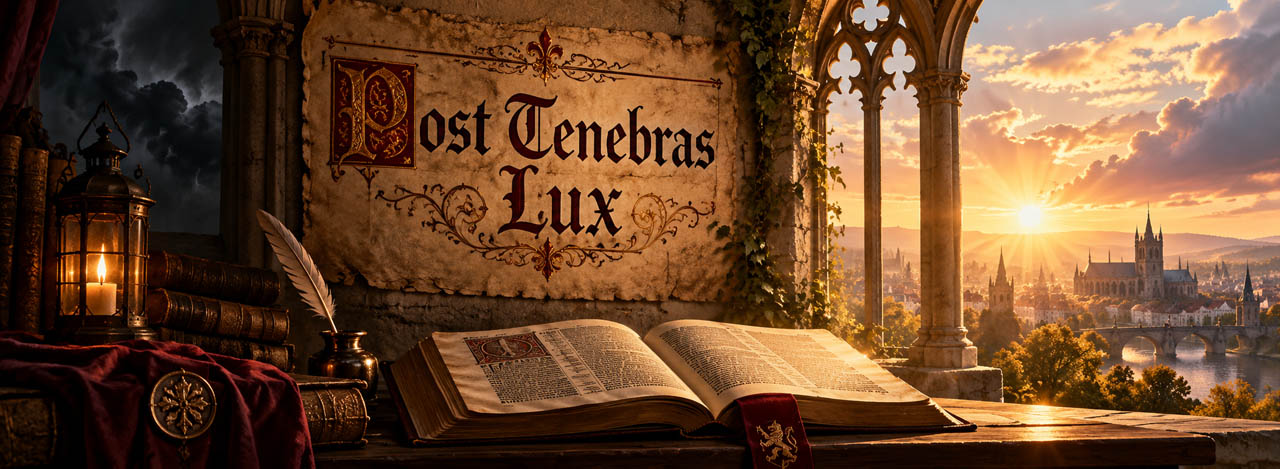
After Darkness, Light
The story of Geneva’s motto, Post Tenebras Lux, and how the recovered gospel brought the light of Christ out of medieval darkness.
After Light, Darkness
A survey of the theological and institutional developments that carried the church from apostolic light into the darkness preceding the Reformation.
Anselm of Canterbury
The Benedictine archbishop who sought “faith seeking understanding” and taught that Christ’s death made satisfaction to God.
Benedict of Nursia
The abbot of Monte Cassino whose Rule became the pattern for monastic life in the West.
Bernard of Clairvaux
The Cistercian abbot, preacher, and mystic whom Calvin regarded as the major witness to truth between Gregory the Great and the Reformation.
Boethius
The Roman statesman and philosopher, “last of the Romans, first of the scholastics,” who wrote The Consolation of Philosophy in prison.
Boniface
The English monk who evangelized the Germans and bound their churches to the bishop of Rome.
Columba
The Irish monk who founded Iona and carried the gospel to the Picts and Scots.
Gottschalk of Orbais
The Saxon monk who revived Augustine’s doctrine of predestination and died imprisoned for it.
Gregory the Great
The monk-pope who expanded the power of the papacy and set the course of medieval teaching on grace and merit.
History of the Bible
A history of the Bible’s canon, transmission, ancient versions, medieval preservation, printing, Reformation translation, and modern abundance.
John Duns Scotus
The Franciscan “subtle doctor” who taught the primacy of God’s will and championed the Immaculate Conception of Mary.
Maximus the Confessor
The monk who suffered mutilation and exile for confessing that Christ has a true human will as well as a divine one.
Medieval Theologians
Short sketches of the major medieval theologians from Patrick to William of Ockham, and their contributions to Roman Catholic and Reformation theology.
Paschasius Radbertus
The Carolingian abbot who wrote the first doctrinal book on the Eucharist and taught that the bread becomes the very flesh born of Mary.
Patrick of Ireland
The Briton, once a slave in Ireland, who returned as a missionary and planted a monastic church among the Celts.
Peter Abelard
The brilliant Paris teacher who pioneered scholastic method and taught the moral influence theory of the atonement.
Peter Lombard
The author of the Sentences, the textbook of medieval theology, who fixed the number of the sacraments at seven.
Ratramnus of Corbie
The Carolingian monk who answered Radbertus, teaching with Augustine that Christ is present in the Supper spiritually.
The First Council of Lyons
The First Council of Lyons of 1245 under Innocent IV: the deposition of the Emperor Frederick II and a new crusade after the loss of Jerusalem.
The First Council of Lyons
The First Council of Lyons of 1245 under Innocent IV: the deposition of the Emperor Frederick II and a new crusade after the loss of Jerusalem.
The Second Council of Lyons
The Second Council of Lyons of 1274 under Gregory X: a short-lived union with the Greek church, the filioque reaffirmed, purgatory and seven sacraments professed, and the papal conclave established.
The Second Council of Lyons
The Second Council of Lyons of 1274 under Gregory X: a short-lived union with the Greek church, the filioque reaffirmed, purgatory and seven sacraments professed, and the papal conclave established.
The Venerable Bede
The English monk-scholar whose Ecclesiastical History is our chief source for the early English church.
Thomas Aquinas
The greatest theologian of the Middle Ages, whose synthesis of Aristotle and Christian doctrine became Rome’s official theology.
William of Ockham
The English Franciscan whose nominalism shaped the late medieval schools and who held Scripture to be the only infallible authority.
