The Geneva Bible
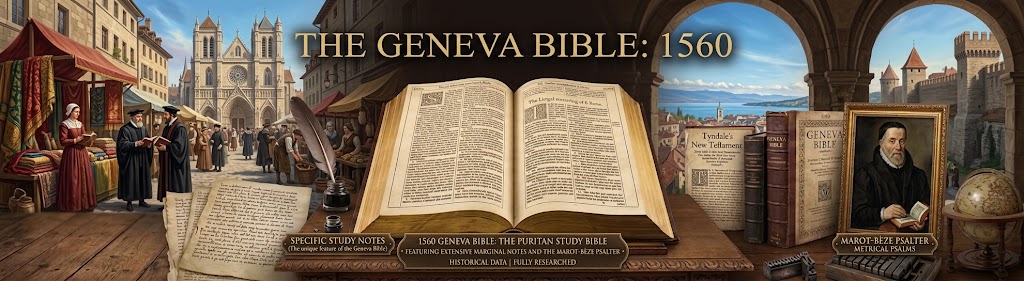
For a hundred years it was the Bible of the English-speaking world. Not the Bible of the court, nor of the cathedral, but of the kitchen table and the saddlebag and the soldier’s coat pocket. It was the Bible Shakespeare quoted and Bunyan was raised on. It was the Bible the Pilgrims carried across the Atlantic. It was the Bible of the Puritans, and it was the Bible the Puritans died with.
It was made by refugees. They had watched their friends burn. They had lost everything but the languages in their heads, and with those they gave the English people the best Bible they had ever held — and the first one furnished, page by page, to be understood.
The men who made it said what they were doing and why, and no summary improves on their own words:
We thought that we should bestow our labours and study in nothing which could be more acceptable to God and comfortable to his Church than in the translating of the Holy Scriptures into our native tongue.1 Preface to the Reader, Geneva Bible (1560)
Out of the Fire
Mary Tudor came to the throne in 1553 and set herself to undo the English Reformation. The public use of the Scriptures was forbidden. Rogers went to the stake, and Cranmer after him. Something near three hundred were burned in five years.
William Bradford, who would one day govern Plymouth, recorded from Foxe what happened to the rest:
Mr. Foxe recordeth how that besids those worthy martyrs and confessors which were burned in queene Mary’s days and otherwise tormented, many (both studients and others) fled out of the land, to the number of 800. And became severall congregations. At Wesel, Frankfort, Basel, Emden, Markpurge, Strasburg and Geneva, etc.2 William Bradford
Eight hundred exiles, scattered across seven cities. One of those congregations would give England its Bible.
They did not arrive at Geneva by accident. In 1554 a company of them gathered at Frankfurt and fell into bitter dispute over the form of worship. William Whittingham, Fellow of All Souls, Oxford, sided with the thoroughly Reformed position argued by John Knox. That position did not prevail, and Knox and his friends removed to Geneva.3
It was the best thing that could have happened to the English Bible. The men who lost the argument at Frankfurt were the men who would not compromise, and they went to the one city in Europe where they did not have to.
“The Most Perfect School of Christ”
Geneva in the 1550s was the finest school of biblical scholarship in Europe. John Calvin was there, in the full maturity of his labors. Theodore Beza was there, whose reputation as a New Testament scholar stood higher than any man’s in the age. A French revision of the Bible was under way in the same city, and the English exiles were in consultation with the men doing it.4
Knox, who had seen a good deal of Europe and was not given to flattery, left the verdict that has never been improved upon. Geneva, he said, was
the most perfect school of Christ that was ever on earth since the days of the apostles.5 John Knox
That is the soil this Bible grew in. For the first time since Tyndale fled England, Englishmen translating the Scriptures had the leisure, the library, the colleagues, and the safety to do the work properly — and they had Calvin and Beza at their elbow.
Knox was made pastor of the English-speaking congregation at Geneva in 1556, and he threw himself into the project. Working alongside his closest friend, Christopher Goodman, Knox led the endeavor to produce the first study Bible in the English language.6
Whittingham’s New Testament, 1557
The first fruit appeared in 1557: a New Testament, printed at Geneva by Conrad Badius, largely the unaided work of Whittingham — who was himself a relative of Calvin, and who worked under Calvin’s own patronage. Calvin contributed the preface.7
It was a small octavo — in Kenyon’s phrase, “the handiest form in which the English Scriptures had yet been given to the world.” And it carried three innovations that every English Bible since has inherited.
Roman type. It was the first English New Testament printed in clean roman letter rather than the heavy black letter of the Great Bible. At a stroke the page became legible to ordinary eyes.
Numbered verses. Earlier English Bibles were divided only into paragraphs. Whittingham adopted the short verse divisions Robert Stephanus had devised for his Greek Testament of 1551 — “for the profit of the reader,” as he put it. Extended to the whole Bible in 1560, those divisions passed into the Authorized Version and into every English Bible you have ever opened.8
Italics for supplied words. Where the translators had to add a word to make English of the Hebrew or Greek, they set it in a different face, so the reader could see exactly where the translator had helped him. It is an act of honesty toward the reader, and it too came down into the Authorized Version.
Whittingham described the readers he had in view as the “simple lambs” of Christ’s fold, some already gathered and some still wandering through ignorance, and claimed to have left nothing unexpounded that an ordinary student of Scripture might find hard. That pastoral aim — Scripture explained, not merely delivered — is the seed of everything the Geneva Bible would become.
The Inheritance of Tyndale
And here is the thing that ought to be said first about the Geneva Bible, and is usually said last.
It is Tyndale’s.
The New Testament the Genevan revisers began from was not the official Great Bible but Matthew’s — which is to say William Tyndale, revised against Stephanus’s Greek text of 1550.9 The debt can be measured. Milligan collates Philippians 2:5–11 in Whittingham’s Testament and finds it agreeing with the Great Bible against Tyndale in a single place, and with Tyndale against the Great Bible in no fewer than seven.10
Tyndale was strangled and burned outside Brussels in 1536, praying that God would open the King of England’s eyes. He never saw a printed page of the Geneva Bible. But the cadence of it is his, the vocabulary is his, and something near nine-tenths of the English is his.
The exiles at Geneva knew exactly whose shoulders they stood on. They were finishing a work begun by a man who had died for it, with tools he had not lived to possess — Beza’s scholarship, Stephanus’s Greek, Calvin’s city, and time enough to do it right.
Kenyon’s summary of the result puts both halves together: “The result was a version which completely distanced its predecessors in scholarship, while in style and vocabulary it worthily carried on the great tradition established by Tyndale.”
The Work: 1560
A Psalter appeared in 1559. The complete Bible followed the next year, printed at Geneva by Rowland Hall, its production costs met out of the pockets of the English congregation there.11
The title page announced the method:
The Bible and Holy Scriptures conteyned in the Olde and Newe Testament. Translated according to the Ebrue and Greke, and conferred with the best translations in diuers languages. With moste profitable annotations vpon all the hard places, and other thinges of great importance, as may appeare in the Epistle to the Reader. Geneva Bible (1560)
It was dedicated to Queen Elizabeth, who had come to the throne in 1558 and made return possible. The epistle to the brethren at home is dated from Geneva, April 10, 1560.
In one respect it broke with everything before it. This was the work of no single scholar but of a company — the first English Bible made by a committee. Alongside Whittingham, who succeeded Knox as minister of the English congregation and appears to have been responsible for most of the New Testament and for the general editing, the principal workers were Thomas Sampson, formerly dean of Chichester, and Anthony Gilby of Christ’s College, Cambridge. Miles Coverdale, Christopher Goodman, William Cole, and Knox himself had a hand in it, though the veterans did not all remain to see it finished. Calvin and Beza advised throughout.12
They were two years at it, and they tell us what those two years cost:
God knoweth with what fear and trembling we have been now, for the space of two years and more day and night occupied herein … though the time then was most dangerous and the persecution sharp and furious.13 Epistle to the Reader, Geneva Bible (1560)
Their Own Account of the Book
The preface to the Geneva Bible is one of the noblest pieces of English prose the Reformation produced, and it deserves to be read rather than described. Here is how these men understood the book they were translating:
… the knowledge and practicing of the word of God, which is the light to our paths, the key of the kingdom of heaven, our comfort in affliction, our shield and sword against Satan, the school of all wisdom, the glass wherein we behold God’s face, the testimony of his favour, and the only food and nourishment of our souls.14 Geneva BibleEpistle to the Reader, 1560
Seven images in a single breath, and not one of them decorative. Light, key, comfort, shield, sword, school, glass, food. That is a doctrine of Scripture, and it is the doctrine that produced the apparatus.
On their fidelity to the text they made a claim, and staked their consciences on it:
And this we may with good conscience protest, that we have in every point and word, according to the measure of that knowledge which it pleased almighty God to give us, faithfully rendered the text, and in all hard places most sincerely expounded the same. For God is our witness that we have by all means endeavored to set forth the purity of the word and right sense of the Holy Ghost for the edifying of the brethren in faith and charity. Geneva BibleEpistle to the Reader, 1560
Milligan’s verdict on that claim is the one scholarship has confirmed: “That the Genevan translators are entitled to make this claim, scholars who have critically examined their work are fully agreed. Every page proves that no efforts were spared to follow as correct a text as possible, and that the best available aids were freely consulted.”15
They also explained why they had kept Hebrew idiom in English even where it sounded strange — and the reasoning is worth any translator’s attention:
Now as we have chiefly observed the sense, and labored always to restore it to all integrity, so have we most reverently kept the propriety of the words, considering that the Apostles who spake and wrote to the Gentiles in the Greek tongue, rather constrained them to the lively phrase of the Hebrew than enterprised far by mollifying their language to speak as the Gentiles did. Geneva BibleEpistle to the Reader, 1560
The apostles bent Greek to fit Hebrew rather than smoothing Hebrew into Greek. So the Genevans bent English. They would rather the reader worked a little than that he lost the shape of what the Spirit had said.
The First Study Bible
What made this Bible revolutionary was not only the accuracy of its text but everything they built around it. The preface catalogs the apparatus, and the list reads like the contents page of a modern study Bible — four hundred and sixty-five years early:16
- Annotations on all the hard places, gathered from the best commentaries and from conference with learned brethren
- Alternative readings marked in the margin with a distinguishing symbol
- More literal renderings of difficult Hebrew idiom noted separately
- Supplied words set in a different type, so the reader can identify them
- Cross-references marked with a star
- Principal matters flagged with a paragraph mark
- Arguments prefixed to every book and every chapter
- A notable word or sentence set at the head of each page as a memory aid
- Diagrams and figures for obscure passages in Moses, Kings, and Ezekiel — “that they which cannot by judgment … attain thereunto, yet by the perspective, and as it were by the eye may sufficiently know the true meaning”
- Maps of cosmography for places named in both Testaments
- Two tables — one interpreting the Hebrew names, one indexing the chief matters of the whole Bible
“So that nothing (as we trust) that any could justly desire, is omitted.”
And it was a book a family could own. Coverdale’s, Matthew’s, and the Great Bible had all been vast folios, fit for a lectern and useless in a house. The Geneva Bible was a moderate quarto at a moderate price. Kenyon marks the significance exactly: it “achieved instant and long-enduring popularity as the Bible for personal use.”
A Bible you could carry, read, and understand. No one in England had ever held such a thing.
The Margin That Preached Christ
The annotations are the most famous feature of this Bible and the most caricatured. They are remembered for their Calvinism and their anti-papal edge, and some of them earn the reputation. But Milligan, who read them all, reports that “the great majority are simply explanatory or hortatory.”17
What is almost never said is that the Geneva margin preaches Christ — and preaches him from the Old Testament, in a household Bible, three generations before the Puritan commentators most of us quote.
Open the genealogy in Matthew 1. At the name of Thamar, where a modern reader hurries past an ugly story, the Genevan annotator stops and finds the gospel in it:
By incestuous adultery, the which shame setteth forth his great humility, who made himself of no reputation, but became a servant for our sakes: yea, a worm and no man, the reproach of men, and contempt of the people, and at length suffered the accursed death of the cross.18 Geneva Biblemarginal note, 1560
Three verses later, at Rachab and Ruth:
Rachab and Ruth, being Gentiles, signify that Christ came not only of the Jews, and for them, but also of the Gentiles, and for their salvation. Geneva Biblemarginal note, 1560
At the name of Christ in verse 16:
Who is the true King, Priest, and Prophet anointed of God to accomplish the office of the redeemer. Geneva Biblemarginal note, 1560
At Emmanuel:
God is joined with us by the means of Jesus Christ, who is both God and man. Geneva Biblemarginal note, 1560
At the Spirit and fire of Matthew 3:11:
When God baptizeth inwardly with the virtue of his Spirit, he burneth, and consumeth the vices and inflameth the hearts with love toward him. Geneva Biblemarginal note, 1560
At the fan in the Lord’s hand:
Which is the preaching of the Gospel, whereby he gathereth the faithful as good corn, and scattereth the infidels as chaff. Geneva Biblemarginal note, 1560
At the voice from heaven:
The favour of God rested on Jesus Christ, that from him it might be poured on us, which deserve of ourselves his wrath, and indignation. Geneva Biblemarginal note, 1560
And at the temptation in the wilderness, in nine words that a preacher could build a sermon on:
To the end that he overcoming these temptations might get the victory for us. Geneva Biblemarginal note, 1560
That is the margin the Puritans read every day for a hundred years. It is not hard to see where they got their habits.
“The Very Substance of This Gospel”
The Argument prefixed to the Gospels shows the same instinct at greater length. It explains why four writers were given, how they differ in style and agree in purpose, and then arrives here:
So that hereby we are admonished to forsake the world, and the vanities thereof, and with most affectioned hearts embrace this incomparable treasure freely offered unto us: for there is no joy nor consolation, no peace nor quietness, no felicity nor salvation, but in Jesus Christ, who is the very substance of this Gospel, and in whom all the promises are yea, and amen.19 Geneva Biblemarginal note, 1560
On the Fourth Gospel the same Argument observes, quoting “a most learned interpreter,” that the other three describe the body while John sets before our eyes the soul — so that John is aptly termed “the key which openeth the door to the understanding of the others.”
This is a study Bible whose apparatus exists to bring the reader to Christ. That is the whole justification for a margin, and the Genevans understood it.
The Craft
The scholarship holds up, and in places it outran everything for three centuries.
At Matthew 28:14 the Genevans caught that the soldiers feared a judicial hearing before the governor, where Tyndale and the Great Bible had suggested mere hearsay reaching the ruler’s ears. At James 1:13 they gave the correct sense — God cannot be tempted with evil — where Wycliffe and Tyndale had God not tempting unto evil. And at James 1:17 they caught the full force of the figure, “with whom is no variableness, neither shadowing by turning” — a rendering no English version matched again until the Revised Version of 1881.20
The refinements between 1557 and 1560 are small and tell you everything about the care taken. In Philippians 2, “shape of God” became “form of God”; “a Name above all names” became “a name above every name”; “the praise of God the Father” became “the glory of God the Father.” As Milligan says, the very minuteness of the changes is the proof of the labor.
One rendering gave the book its affectionate nickname. At Genesis 3:7 Adam and Eve sew fig leaves together and make themselves breeches — whence the Breeches Bible, as collectors have called it ever since.
The Bible of a People
The Geneva Bible was never authorized for public reading in the churches of England. It did not need to be. It arrived and took possession of the English home.
Kenyon states the fact that matters most, and it is worth reading twice:
For a full century it continued to be the Bible of the people, and it was upon this version, and not upon that of King James, that the Bible knowledge of the Puritans of the Civil War was built up. Its notes furnished them with a full commentary on the sacred text.21 Frederic Kenyon
A full century. Through Elizabeth, through the rise of Puritanism, through the Separatist flight to Holland, through the sailing of the Mayflower, through the Civil War — the Bible in English hands was this one. It was the Geneva translation, not the King James, that Shakespeare used and that the early American Puritans carried.22
One small relic proves how deep it had gone. The pocket Bible carried by the soldiers of the Commonwealth army was not a whole Bible but a booklet of apt verses, printed small enough for a coat. Every quotation in it was taken from the Geneva version. The first heading reads: A Souldier must not doe wickedly.23
Men marched with this Bible in their pockets. Families read it at table. Ministers preached from it for a hundred years. Its notes taught a generation of English Christians how to read the Scriptures, and those Christians became the Puritans.
The Puritan debt is direct and acknowledged. The single most unifying conviction of all the Puritans was their commitment to the Word of God as the highest authority in life — that the Scriptures should be translated and made available to everyone. The fruit of that conviction was Tyndale’s work, the Geneva Bible, and at last the King James Version.
The Bible of Scotland
In 1579 the Geneva Bible became the first Bible ever printed in Scotland — the Bassandyne Bible, named for the printer Thomas Bassandyne, though he died before publication and his name does not appear on the finished work. The New Testament had gone ahead of it in 1576.24
Scotland received it the way Knox would have wanted. The General Assembly fixed its price at £4 13s 4d Scots, and an Act of Parliament bound every householder of substance to own a copy. This was no dead letter: in June 1580 one John Williamson was commissioned to visit and search every house in the realm and require sight of the family’s Bible and Psalm book, each marked with the owner’s name so that copies could not be borrowed round to fool the inspector. The magistrates of Edinburgh added their own proclamation, helpfully noting where one could be bought — in Andrew Williamson’s merchant booth, beside the Meal Market.
It was appointed to be read in the Scottish churches, and it formed the piety of a nation. Knox had gone home from Geneva in 1559 at Calvin’s urging; twenty years later the Bible he had helped begin was in every substantial house in Scotland.
Tomson and Junius
The Geneva text was never given a complete revision, but its New Testament was reworked once. In 1576 Laurence Tomson (1539–1608), secretary to Sir Francis Walsingham and formerly a lecturer in Hebrew at Geneva, published an amended New Testament following Beza more closely still, drawing on Beza’s Greek text, Latin version, and commentary of 1565. From 1587 Tomson’s Testament was generally substituted for that of 1560 in fresh printings. In 1598 the annotations on Revelation by the Huguenot divine Franciscus Junius were added.25
A point of ordinary care for anyone quoting from the margin. The annotations differ by edition. A note found in a 1599 or 1602 printing may be Tomson’s or Junius’s rather than the work of the 1560 company, and the facsimiles most commonly reprinted today are of later editions. Cite the edition, not simply “the Geneva Bible.” Every note quoted on this page is from the 1560 text.
What the King Could Not Forgive
At Hampton Court in January 1604, when John Rainolds asked James for a new translation on grounds of accuracy, the king agreed readily — and for a different reason, which he did not trouble to conceal.
Prompted by Richard Bancroft, bishop of London, James stipulated that the new version carry no marginal notes. He had found the notes in the Geneva Bible — in a copy given him by an English lady — to be partial, untrue, seditious, and favoring too much of dangerous and traitorous conceits. He objected in particular to the note at 2 Chronicles 15:16 suggesting that King Asa’s mother should have been executed rather than merely deposed. Barlow records his blunt verdict: he had never yet seen a Bible well translated into English, but the worst of all he thought the Geneva to be.26
It was not the translation he objected to. It was the margin — and specifically the margin’s willingness to apply the Word of God to the conduct of kings.
That is not a criticism of the Geneva Bible. That is its commendation. A Bible that no monarch can be comfortable with is a Bible doing its work.
And note what followed. The Authorized Version appeared in 1611 and did not sweep the field. Geneva Bibles went on being printed for more than thirty years, the last edition in 1644, and even opponents of Puritanism went on preaching from the “hotter” version. The King James translators, for their part, made extensive use of Geneva in their work. The book James disliked shaped the book he commissioned.
Of the Incomparable Treasure
From 1578 most printings carried, on the leaf after the title page, a poem on the treasure of Scripture. It is plain verse, and it says in eight lines what the whole enterprise was for:
Here is the Spring where waters flow,
to quench our heat of sin:
Here is the Tree where truth doth grow,
to lead our lives therein:
Here is the Judge that stints the strife,
when men’s devices fail:
Here is the Bread that feeds the life,
that death cannot assail.
The tidings of Salvation dear,
comes to our ears from hence:
The fortress of our Faith is here,
and shield of our defence.27
Geneva Biblecommendatory verse, 1578
And then it turns and speaks to the man holding the book:
Read not this book, in any case,
but with a single eye:
Read not, but first desire God’s grace,
to understand thereby.
Pray still in faith, with this respect,
to fructify therein,
That knowledge may bring this effect,
to mortify thy sin.
Then happy thou, in all thy life,
whatso to thee befalls:
Yea, double happy shalt thou be,
when God by death thee calls.
Geneva Biblecommendatory verse, 1578
Beneath it stood a prayer, printed for the reader to pray before he began:
O Gracious God and most merciful Father, which hast vouchsafed us the rich and precious jewel of thy holy Word, assist us with thy Spirit, that it may be written in our hearts to our everlasting comfort, to reform us, to renew us according to thine own image, to build us up, and edify us into the perfect building of thy Christ, sanctifying and increasing in us all heavenly virtues. Grant this, O heavenly Father, for Jesus Christ’s sake. Amen. Geneva Bibleprayer before reading, 1578
Consider what that means. Before a plowman in Kent or a weaver in Norwich read a word of Scripture, his Bible handed him a prayer to pray. Not a prayer for information, but for transformation — to be reformed, renewed according to God’s own image, built up and edified into the perfect building of Christ.
No committee that merely wanted to sell books would have printed that.
Carved in Stone
Walk today along the old city wall at Geneva, beneath the university, and you will come to the Reformation Wall. Farel, Calvin, Beza, and Knox stand together in stone, fifteen feet high, and the reliefs around them tell the story of what came out of that city — Coligny and the Huguenots, William the Silent and the Dutch, Roger Williams and the Mayflower Compact.
On the right-hand end, John Knox is shown preaching in St Giles, Edinburgh. And carved above him, in English, is the Lord’s Prayer — in the Geneva translation.28
The exiles came to Geneva with nothing. They left it having given the English-speaking world its Bible. And on the monument that city built to its own Reformation, the words over Knox’s head are the words those refugees made.
Legacy
Nearly everything a modern reader takes for granted in an English Bible came from Geneva first: the readable type, the numbered verses, the italicized supplements, the cross-references, the book introductions, the maps, the index, the study notes. Above all, the conviction that ordinary Christians should be given not only the text but the helps to understand it.
It ran to well over a hundred editions — the counts in the sources range from about 130 to over 160 — with the last in 1644.29 It was the Bible of the Puritans, of the Scottish Kirk, of the Pilgrim fathers, and of a century of English homes.
And it was made by men with nothing. No royal commission. No printing monopoly. No cathedral, no patron, no salary. They had been driven out of their own country under threat of burning, and they paid for the printing out of a refugee congregation’s collection.
They gave England the best Bible it had ever had, and then handed it to the country that had expelled them.
Therefore, as brethren that are partakers of the same hope and salvation with us, we beseech you, that this rich pearl and inestimable treasure may not be offered in vain, but as sent from God to the people of God, for the increase of his kingdom, the comfort of his Church, and discharge of our conscience … that God in us may be fully glorified through Christ Jesus our Lord, who liveth and reigneth for ever. Amen. Geneva BibleEpistle to the Reader, 1560
Sources
- Geneva Bible, epistle to the reader (Geneva, April 10, 1560); quoted also in George Milligan, The English Bible: A Sketch of Its History (London: A. & C. Black, 1895), ch. 10, §1. ↩
- William Bradford, Of Plymouth Plantation, citing Foxe; quoted in Manuel Pereira, “The English Puritans.” ↩
- “Whittingham, William,” Encyclopædia Britannica, 11th ed. (1911). ↩
- Frederic G. Kenyon, “English Versions,” in Dictionary of the Bible, ed. James Hastings (New York: Charles Scribner’s Sons, 1909); Milligan, ch. 10, §3. ↩
- John Knox, quoted in “Notes on John Knox” (Reformation Stewards teaching materials). ↩
- “Notes on John Knox,” on Knox’s pastorate of the English congregation at Geneva from 1556 and his partnership with Christopher Goodman. ↩
- Kenyon, “English Versions”: “It was by a relative of Calvin, and under his own patronage, that the work of improving the English translation of the Bible was once more taken in hand … A preface was contributed by Calvin himself.” ↩
- Milligan, ch. 10, §2. ↩
- Kenyon, “English Versions”; Michael D. Marlowe, bibliographical notes on the Geneva Bible, Bible Research. ↩
- Milligan, ch. 10, §2, collating Philippians 2:5–11 in Whittingham 1557 against Tyndale 1534 and the Great Bible. ↩
- Kenyon, “English Versions”; Milligan, ch. 10, §3. ↩
- Kenyon, “English Versions”; Milligan, ch. 10, §3; Marlowe, bibliographical notes; “Notes on John Knox.” ↩
- Geneva Bible, epistle to the reader, 1560. ↩
- Geneva Bible, epistle to the reader, 1560. ↩
- Milligan, ch. 10, §3. ↩
- Geneva Bible, epistle to the reader, 1560, where the translators set out the whole apparatus; Kenyon, “English Versions,” on the format and popularity. ↩
- Milligan, ch. 10, §4. ↩
- Notes on Matthew 1–4 from the 1560 edition, as reproduced from the photographic facsimile in Lloyd E. Berry, ed., The Geneva Bible: A Facsimile of the 1560 Edition (Madison: University of Wisconsin Press, 1969). The notes quoted in this section are all from that text. ↩
- “The Argument” prefixed to the Gospels, Geneva Bible, 1560 (Berry facsimile). ↩
- Milligan, ch. 10, §3. ↩
- Kenyon, “English Versions.” ↩
- David M. Scholer, “Did You Know?” Christian History 43 (1994). ↩
- Milligan, ch. 10, §5. ↩
- Milligan, ch. 10, §6. ↩
- Marlowe, bibliographical notes, citing Bruce M. Metzger, “Book Notes,” Theology Today 46/4 (January 1990), 463; Milligan, ch. 10, §6; Kenyon, “English Versions.” ↩
- William Barlow, The Sum and Substance of the Conference … at Hampton Court (1604). The conference is dated January 1603 Old Style, January 1604 by modern reckoning. ↩
- “Of the incomparable Treasure of the Holy Scriptures, with a prayer for the true use of the same,” printed after the title page in most Geneva Bibles from 1578. ↩
- Notes on the International Monument to the Reformation, Geneva (Reformation Stewards teaching materials): the Knox relief shows him preaching in St Giles, Edinburgh, with the Lord’s Prayer inscribed above it in English, from the Geneva translation. ↩
- Milligan, ch. 10, §5 (“more than 130 editions”); Kenyon, “English Versions” (“over 160”); Tony Lane, “The Crown of English Bibles,” Christian History 43 (1994) (“no fewer than 140”). ↩
Further Reading
- Lloyd E. Berry, “Introduction,” in The Geneva Bible: A Facsimile of the 1560 Edition (Madison: University of Wisconsin Press, 1969)
- Lewis Lupton, A History of the Geneva Bible, 25 vols. (London: Faulkonberg Press, 1967–1994)
- Charles Eason, The Genevan Bible: Notes on its Production and Distribution (Dublin: Eason and Son, 1937)
- Christina Hallowell Garrett, The Marian Exiles (Cambridge, 1938)
- Irena Dorota Backus, The Reformed Roots of the English New Testament: The Influence of Theodore Beza on the English New Testament (Pittsburgh: Pickwick Press, 1980)
- Mary A. E. Green, ed., The Life of Mr. William Whittingham (London, 1870)
- Gerald T. Sheppard, ed., The Geneva Bible: The Annotated New Testament, 1602 Edition (New York: Pilgrim Press, 1989)