Tyndale’s New Testament
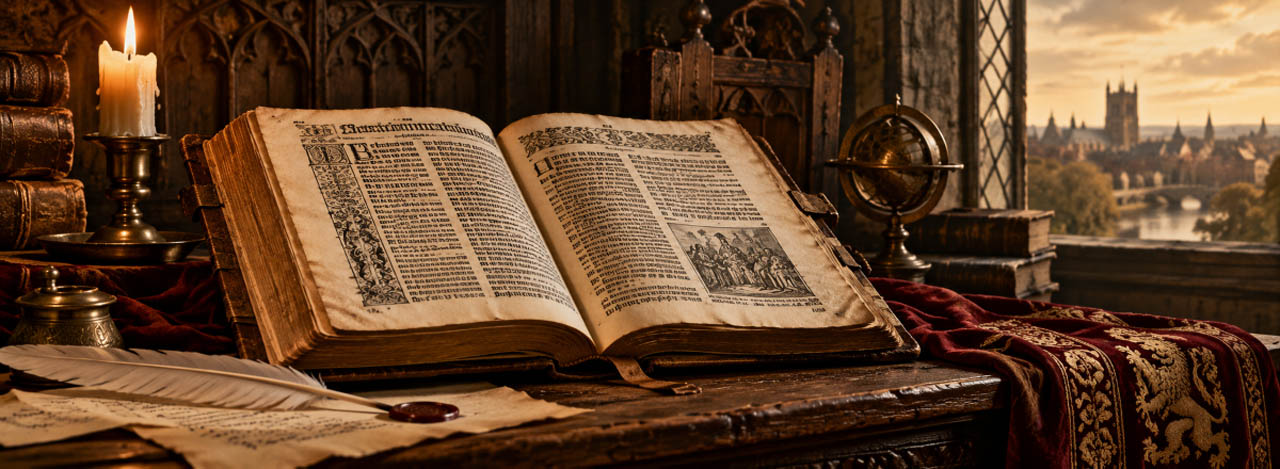
It is a small book. An octavo, roughly the size of a paperback, printed without a title page, without the translator’s name, and without a single marginal note. It was made in a foreign city by a hunted man, smuggled home in bales of cloth, and burned in the churchyard of St Paul’s by the bishop who had refused to help produce it.
Of the several thousand copies printed at Worms in 1526, three are known to survive. From that book descends, by direct line, nearly every English Bible that has ever been read. Roughly nine-tenths of the King James New Testament is Tyndale’s wording. The man who wrote it was strangled and burned ten years later, and did not live to see one page of the version that would carry his work into three centuries of English-speaking Christianity.
The World That Burned Books
The law under which Tyndale worked was the Constitutions promulgated at Oxford under Archbishop Arundel in 1408, which forbade any man on his own authority to translate any text of Scripture into English, or to read such a translation, in part or in whole.1 It was enforced against people, not merely against books.
On the fourth of April, 1519, seven people were burned alive at Coventry for teaching their own children the Lord’s Prayer in English. One was a woman remembered only as Mistress Smith. She had been released and was being led away when the officer heard paper rustling in her sleeve — a crumpled copy of the Lord’s Prayer, the Creed, and the Ten Commandments in her own tongue. He turned her around, and she burned with the six men.2
That is the England into which Tyndale was born. It is worth sitting with, because five hundred years later we own Bibles we do not open.
This One Thing
William Tyndale (c. 1494–1536) was a Gloucestershire man, Oxford-trained, ordained, and by every ordinary measure destined for a quiet clerical career. He had instead a single consuming conviction: that the Scriptures must be put into English from the Greek and the Hebrew, and placed in the hands of people who could not read a word of Latin.
About 1520, while tutor in the household of Sir John Walsh at Little Sodbury, he fell into argument with a learned man who finally burst out that it would be better to be without God’s laws than the pope’s. Tyndale answered that he defied the pope and all his laws, and added the vow for which he is remembered:
If God spare my life, ere many years, I will cause a boy that driveth the plow to know more of the Scripture than thou dost.3 William Tyndale
Erasmus had said something similar years earlier — that he wished the farmer would sing Scripture at the plow and the weaver hum it at his shuttle. But Erasmus wished. Tyndale said he would. Erasmus preferred to watch the Reformation; Tyndale walked into it and never came home.
He explained his reasoning plainly. He had perceived by experience that it was impossible to establish the laypeople in any truth unless the Scripture were plainly laid before their eyes in their mother tongue, that they might see the process, order, and meaning of the text.
No Room in England
The Constitutions left one loophole: a bishop could authorize the work. So in 1523 Tyndale went to London and sought the patronage of Cuthbert Tunstall, bishop of London — a genuine Greek scholar, a friend of Erasmus, and on paper exactly the man to say yes. Tunstall declined. Martyrdom was not the bishop’s ambition.
Tyndale lodged instead with Humphrey Monmouth, a cloth merchant of the parish of All Hallows, Barking, and spent the better part of a year at his book most part of the day and of the night. His summary of what he had learned is one of the saddest sentences in English church history: not only that there was no room in my lord of London’s palace to translate the New Testament, but also that there was no place to do it in all England.
He crossed to the Continent in 1524 — probably in May, since the Elbe is closed by ice in January — supported by London merchants who traded in cloth. He was about thirty. He never saw England again.4
Years later, appealing through the envoy Vaughan to Henry VIII, he cataloged the cost without self-pity: his pains, his poverty, his exile from his native land, his bitter absence from his friends, his hunger, his thirst, his cold, and the danger with which he was everywhere compassed.
Hamburg, and the Question of Wittenberg
Tyndale settled first at Hamburg. Whether he then went on to confer with Luther at Wittenberg is a question worth handling carefully, because the answer is regularly overstated in both directions.
The visit is affirmed by Foxe, by Cochlæus, by Sir Thomas More, and by Robert Ridley, Tunstall’s chaplain. It appears in a charge brought against Monmouth in 1528, which Monmouth did not deny. When More pressed the accusation, Tyndale answered only the charge of confederacy — “When he says Tyndale was confederate with Luther, that is not truth” — and conspicuously did not deny the visit itself. Eadie’s judgment is that Tyndale had probably been with Luther, though he was certainly never in concert with him.5
The distinction matters. It was common at the time to brand any reforming tendency as Lutheran, and More’s Dialogue speaks of “the pestilent sect of Luther and Tyndale” as though they were one movement. But Tyndale was no sectarian and founded no party. His own disclaimer near the end of his life is worth weighing:
He took God to record to his conscience that in nothing he had written was there any evil purpose of envy or malice toward any man, nor any intent to stir up false doctrine, nor to be author of any sect, nor to draw disciples after himself, nor to be esteemed above the least child that is born — but only out of pity and compassion for the blindness of his brethren, to bring them to the knowledge of Christ.6
Cologne, 1525
In the summer of 1525 Tyndale moved to Cologne with his amanuensis William Roye and put the New Testament to press — a quarto edition with marginal glosses, printed by Peter Quentel. His original intention was a run of six thousand copies, but for fear of mischance he settled for three thousand.
The mischance came anyway. Johann Cochlæus, an energetic enemy of the Reformation, was living in exile at Cologne and using the same printers. From the boasting of the workmen about the great change soon to come in England, he grew suspicious. Unable to get near the two Englishmen, he invited some of the printing-house men to his lodgings and plied them with wine — a detail he records himself, without embarrassment. Over their cups they told him that three thousand copies of a Lutheran New Testament in quarto were at press, that ten sheets were already printed, that English merchants would bear the cost, and that the books would be in England before king or cardinal knew of it.
Cochlæus went to the patrician Herman Rinck, Rinck went to the authorities, an inquiry confirmed the report, and the senate interdicted the printer. Tyndale and Roye snatched up the printed sheets and fled by ship up the Rhine to Worms.7
Cochlæus also wrote ahead to warn the king, Wolsey, and the bishop of Rochester to watch the ports against this most pernicious merchandise. He had, in the event, accomplished nothing except to make the book smaller and harder to find.
Worms, 1526
Printing resumed at Worms, probably in October 1525, in a city then wholly given over to the Reformation — the same city where Luther had stood four years before. Two editions came off the press: the quarto was completed, and an octavo without glosses was set and finished, three thousand copies of each.
Tyndale gave priority to the octavo, and the reason is tactical. Suspecting that Cochlæus would have written to England, he pressed forward with a plain, small, unannotated volume that might travel without attracting attention. The glosses were what the authorities were watching for; a naked text was easier to hide and harder to condemn. It is a translator’s decision made under surveillance, and it shaped the book that actually reached English hands.8
He was candid about the roughness of a first attempt. In the epistle at the end of the octavo he asks that the rudeness of the work at the first time offend not his readers, and promises to mend it.
The octavo was probably printed by Peter Schœffer, son of the first printer at Mainz, who had left his native city over his Protestantism. The identification rests on the type, the sheet size, the number of lines to the page, and the watermark in the paper, all matching other books from his press.
The two issues differ in perhaps fifty readings, and most of the octavo’s peculiar readings carry forward into Tyndale’s later editions — evidence that he revised as he went. At Matthew 20:23 the quarto reads “to give you,” following a word that had come in from the Vulgate; the octavo rightly drops it.
Of the Cologne quarto, one fragment survives — thirty-one leaves carrying the prologue and Matthew through 22:12, discovered in 1836 by the London bookseller Mr. Rodd and now in the British Library. The press was identified by collating the letter-forms and an initial “y” against works known to be Quentel’s, and by a woodcut which, when the New Testament was abruptly stopped, was pared down to fit another book.
What He Translated From
Tyndale translated the Greek text of Erasmus. He also had Luther’s German version and the Latin Vulgate open beside him, and he used both. The charge that he merely turned Luther into English is old, was politically useful at the time, and is false.
The evidence of dependence is real and should be stated. Tyndale follows Luther’s order of the books rather than Erasmus’s, placing James next to Jude and Hebrews after 3 John. More than half the ninety-two marginal glosses in the surviving quarto fragment are drawn from Luther’s Testament; forty-one are Tyndale’s own. Several prologues rest on Luther’s.
But the handling is anything but slavish, and the places where Tyndale departs are the revealing ones. He omits Luther’s dismissal of James as a strawy epistle. His prologue to Hebrews argues against Luther on the letter’s authority. His prologue to James is likewise directed against Luther, contending that since the epistle agrees with the rest of Scripture, there is no reason it should not be received as Holy Scripture. His prologue to Jude defends its canonicity against Luther’s two objections. And from the prologue to Philemon he quietly drops Luther’s allegory that Christ overcame the Father with love and meekness — a formulation that obscures the Father’s own eternal love in giving the Son.9
A man who corrects Luther on the canon and on the doctrine of the Father is not a man translating Luther.
The opposite charge — that Tyndale worked only from the Vulgate, so that the Authorized Version is ultimately a translation of a translation — rests on a tangle of bibliographical errors and does not survive contact with the text.10
The English of It
What Tyndale produced was English of a kind that had not existed before: racy Saxon, plain, concrete, with the ring of genuine idiom, more definite and concise than the prose of his own day and even than his own polemical writing. He that reads may understand, and the plowboy may gather the sense in his own tongue.11
Three choices in particular enraged the authorities, and none of them is a matter of style. Tyndale rendered the Greek as repent rather than do penance, congregation rather than church, elder rather than priest. Each dismantles a sacramental structure the church had built upon the Latin. The bishops understood precisely what was being done to them.
He also gave English much of its religious vocabulary. Passover, atonement, mercy seat, scapegoat, peacemaker, longsuffering, intercession, judgement seat, filthy lucre, and beautiful all entered the language through his work.
Smuggled Home
The books reached England in the spring or early summer of 1526 — not in January, as some older accounts have it, since the printing at Cologne cannot have begun much before September 1525.12 By April they were selling.
Getting them there required a conspiracy. Loose printed sheets went into bales of cloth and watertight casks of wine and oil, down the Rhine, across the North Sea, into Norwich and Bristol and London, where believers waited on the docks. Foxe reports that one farmer traded a wagonload of hay for a copy of the Epistle of James.
Thomas Garret carried them to Oxford and sold them to divers scholars; a small congregation formed there around the reading of them, its members calling one another brethren. When the search came, Garret was confined in the commissary’s chamber and escaped by pushing back the bar of the lock with his finger.
In Chelmsford a fifteen-year-old named William Malden watched poor men of the town buy a New Testament and sit reading it aloud at the back of the parish church on Sundays, a crowd gathering to listen. His father forbade him to go, and told him he could get all the Bible he needed from Latin matins. So the boy taught himself to read, got a copy of his own, hid it in his straw bed, and took a beating for it.13
That is what Tyndale meant by the plowboy. Not a slogan. A fifteen-year-old with a contraband book in his mattress.
Burned
On the twenty-fourth of October, 1526, Tunstall preached against Bible translation and had Tyndale’s New Testament burned in the churchyard of St Paul’s. Henry VIII, in a letter to his subjects printed in December of that year, denounced the certain prefaces and pestilent glosses in the margin of the quarto and declared his purpose that the untrue translation should be burned.14
The burnings did not stay confined to paper. Men who read the book, sold it, or shipped it went to the stake as well.
Then came the episode that has delighted Protestants ever since. Returning from the Treaty of Cambray in 1529 by way of Antwerp, Tunstall let it be known that he would gladly buy up the unsold New Testaments. A London mercer named Augustine Packington — who secretly favored Tyndale — offered to obtain every copy in the city, for a price. The bishop, in the chronicler Halle’s phrase, thought he had God by the toe. Packington went to Tyndale and told him who the buyer was. Tyndale saw the bargain at once: he would be freed of debt, the world would cry out against the burning of God’s Word, and the surplus would fund a corrected edition.
“So forward went the bargain, the bishop had the books, Packington had the thanks, and Tyndale had the money.”15
The corrected Testaments duly came over thick and threefold. When the bishop asked Packington how this could be, Packington advised him that as long as the printers had the letters and the stamps it would never be better — so his lordship had best buy the type as well.
Revision
Tyndale kept his promise to mend the work. He issued a thoroughly revised New Testament in 1534, and a further edition in 1535 — the printing Eadie designates GH, which John Rogers would afterward take as his base text when assembling Matthew’s Bible, judging it the last and best of Tyndale’s labor.
He had meanwhile turned to the Old Testament from the Hebrew: the Pentateuch in 1530, with a revised Genesis in 1534, and Jonah in 1531. He completed Joshua through 2 Chronicles but did not live to see it printed. That material appeared in Matthew’s Bible in 1537, where the letters W. T. stand in large ornamented capitals at the close of Malachi.
The Cost
For his last years Tyndale lodged in the English Merchants House at Antwerp. A friend there left an account of his ordinary week: Sundays reading and expounding Scripture to whoever gathered, and again after dinner; Mondays visiting English refugees; Saturdays walking the city, looking into every corner and hole for the elderly, the outcast, and the destitute, and giving away what he had; every other day given wholly to his book. This is the man his enemies called a hell-hound.
He was betrayed by a young Englishman named Harry Phillips, who had been paid to find him, and was taken by night to the castle at Vilvoorde outside Brussels on the twenty-first of May, 1535. He was held sixteen months.
From that cell comes a letter in his own hand to the officer in charge. He asks for a warmer cap, because his head is cold; a warmer coat, the one he has being thin; cloth to patch his leggings; a lamp, since it is wearisome to sit alone in the dark. And above all of it, he begs to be allowed his Hebrew Bible, grammar, and dictionary, that he might spend the time in that study.
A cold man in a dark cell, sixteen months from a fire he could see coming, asking for a lamp and his Hebrew grammar. He was not finished. He was still translating.
On the sixth of October, 1536, he was strangled at the stake and his body burned, at Vilvoorde. He was forty-two. Foxe records his last words as a prayer:
Lord, open the King of England’s eyes. William Tyndale
The Prayer Answered
Within a year Henry VIII had licensed an English Bible. Within three he had ordered one chained in every parish church in the realm.
Miles Coverdale published the first complete printed English Bible in 1535. John Rogers brought out Matthew’s Bible in 1537 under a pseudonym — a volume very largely Tyndale’s work, licensed by the king who had hunted him. The Great Bible followed in 1539 under Cranmer, set by royal injunction in every parish. And when King James’s translators finished in 1611, they were in the main revising Tyndale.
The authorities burned the book and they burned the man. Neither fire accomplished anything.
A Note on the Numbers
Two figures about the 1526 Testament circulate in slightly different forms, and anyone citing them should know why.
The print run. Popular accounts say six thousand copies were printed at Worms. Eadie’s bibliographical treatment is more precise: three thousand quarto and three thousand octavo, the quarto having been begun at Cologne and finished at Worms. Tyndale’s original plan had indeed been six thousand of the quarto alone, reduced to three thousand for safety. Six thousand is a fair total; it is not a single edition.16
Surviving copies. Sources say two or three, and both are right for their date. Eadie in 1876 knew of two octavo copies: one virtually perfect but lacking its title page, then at the Bristol Baptist College, and one imperfect at St Paul’s Cathedral. Christian History still reported two in 1994. The Bristol copy was acquired by the British Library that same year, and a third witness — a fragment now at Stuttgart — came to light in 1996. Three is the current figure; two is what the older literature says, and the difference is discovery, not disagreement.17
Why This History Is Kept
Tyndale was a theologian before he was a translator, and the translating flowed from the theology. Answering Thomas More on whether the church or the gospel came first, he reasoned from Romans 10 that Christ must be preached before anyone can believe — therefore the preacher’s word precedes the hearer’s faith, and since the Word is before the faith, and faith makes the congregation, the Word is before the congregation.
That is sola Scriptura in its cleanest form. The church does not create the Word; the Word creates the church. Rome had inverted the order and built an apparatus of authority upon the inversion. Tyndale put it back the right way round, and then spent his life making sure ordinary people could hold the Word in their hands and check.
He was equally clear about what Scripture is for. The Scriptures, he said, spring out of God and flow into Christ, and were given to lead us to Christ. The Bible is medicine; the point is to apply it to your own sores rather than gnaw the bitter bark and never reach the sweet pith within.
Five hundred years on, the plowboy has his Bible. He has it in a dozen translations, on a device in his pocket, for free. Tyndale would have wept for joy — and then asked whether we read it.
Sources
- The Constitutions of Oxford, promulgated under Archbishop Thomas Arundel, 1408. See James Hastings, ed., “English Versions,” in Dictionary of the Bible (New York: Charles Scribner’s Sons, 1909), which dates the decree to 1408 through the Council of Blackfriars. ↩
- John Foxe, Acts and Monuments, on the Coventry martyrs of April 1519. ↩
- Foxe, as reproduced in Hastings, “English Versions,” and in Philip W. Comfort, “History of the English Bible,” in The Origin of the Bible (Carol Stream, IL: Tyndale House, 2004). John Eadie gives the closing words as “than the Pope did”; Foxe’s “than thou dost” is the standard form. ↩
- John Eadie, Tyndale, ch. 7. Eadie argues for May 1524 against Anderson’s January on the ground that the Elbe is icebound at that season. ↩
- Eadie, Tyndale, ch. 7, weighing Foxe, Cochlæus, More, Ridley, and the 1528 charge against Monmouth. ↩
- Tyndale’s own disclaimer, quoted in Eadie, Tyndale, ch. 7. Paraphrased here; the original is in Tyndale’s later prose. ↩
- Eadie, Tyndale, ch. 7, following Cochlæus’s own account; Tony Lane, “The Crown of English Bibles,” Christian History 43 (1994). ↩
- Eadie, Tyndale, ch. 7. ↩
- Eadie, Tyndale, ch. 9. ↩
- Eadie, Tyndale, ch. 9, answering Macknight and Hallam. ↩
- Eadie, The English Bible (London: Macmillan, 1876), on the character of Tyndale’s prose. ↩
- Eadie, Tyndale, ch. 10, setting out six arguments against the earlier dating proposed by Christopher Anderson. ↩
- Foxe, Acts and Monuments, for Garret, the hay, and William Malden of Chelmsford; Eadie, Tyndale, ch. 10, for Garret at Oxford. ↩
- Eadie, Tyndale, ch. 10, on Henry’s letter of 1526, printed by R. Pynson on December 2, 1526. ↩
- Edward Halle, Chronicle, quoted at length in Eadie, Tyndale, ch. 11. ↩
- Eadie, Tyndale, ch. 7; compare Lane, “The Crown of English Bibles,” and the account in Christian History 43, which give six thousand at Worms. ↩
- Eadie, Tyndale, ch. 7 (two copies, Bristol and St Paul’s); Christian History 43 (1994) (two); the Stuttgart fragment was identified in 1996. ↩
Further Reading
- David Daniell, William Tyndale: A Biography (New Haven: Yale University Press, 1994) — the standard modern life
- David Daniell, ed., Tyndale’s New Testament (New Haven: Yale University Press, 1989) — the 1534 text in modern spelling
- John Eadie, The English Bible: An External and Critical History of the Various English Translations of Scripture, 2 vols. (London: Macmillan, 1876)
- Brian Edwards, God’s Outlaw: The Story of William Tyndale and the English Bible
- Robert Demaus, William Tyndale: A Biography (London, 1871)
- Edward Arber, ed., The First Printed English New Testament (London, 1871) — facsimile of the Cologne quarto fragment