
The Scottish Reformation
Christ’s Crown and Covenant in the Church of Scotland, 1560–1929

 he Church of Scotland was born in a
single season of 1560, yet its story runs on through four centuries of covenants, persecutions,
secessions, and reunions. At every turning the same question pressed upon the Scots: Who is King in the
church? The Reformers answered that Jesus Christ alone is King and Head of His church, and that His
written Word alone must govern her doctrine, worship, and discipline. That conviction gave the Scottish
Reformation its courage. It also produced its divisions, for good men did not always agree on how
faithfully the national church was keeping it.
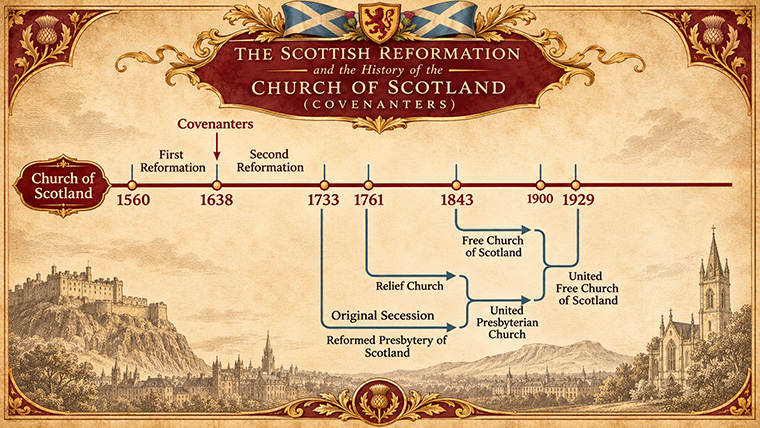
Church history is humbling. It is riddled with sinful ambitions and with partisan zeal on every side. Yet beneath the quarrels of Scottish Presbyterianism runs a golden thread: a people who counted the crown rights of the Redeemer worth more than their livings, their lands, and their lives. The chart below traces the main lines of that history.
The Seedtime of Reform (1528–1559)
The first seed was sown in blood. Patrick Hamilton, a young scholar of noble birth who had gone to the Continent to learn from the Reformers and studied at Marburg, was burned before St. Salvator’s College in St. Andrews on February 29, 1528.1 His enemies meant to silence the new doctrine, but, in the well-known saying, “the reek of Patrick Hamilton infected all on whom it did blow.”2 George Wishart followed him to the stake at St. Andrews on March 1, 1546, and the man who had carried a two-handed sword before Wishart for his protection was a priest from Haddington named John Knox.3 After the galleys, England, and Geneva, Knox arrived in Edinburgh on May 2, 1559. By the next summer the Protestant Lords of the Congregation, with English help, had broken the power of the French regency.4
1560: The Birth of the Church of Scotland
The regent Mary of Guise died on June 10, 1560, and the Treaty of Edinburgh in July sent the French soldiers home. The Estates met in Edinburgh that August. Knox and five colleagues, all named John, drew up a confession of faith in four days. Its title called it “Lailsome and sound doctrine groundit vpoun the infallibill trewth of godis word,” and on August 17 Parliament approved it article by article. Knox describes how the bishops sat silent, and how the Earl Marischal gave his vote:5
It is long since I have had some favor unto the Truth, and since that I have had a suspicion of the Papistical Religion. But I praise my God, who this day hath fully resolved me in the one and the other.6 The Earl MarischalParliament of Scotland, August 1560
On August 24 Parliament abolished the jurisdiction of the pope in Scotland and forbade the Mass.7 The Scots Confession itself opened with a remarkable humility before the Word of God:
If any man will note in this our Confession any article or sentence repugning to God’s Holy Word, if it would please him of his gentleness and for Christian charity’s sake to admonish us of the same in writing, and we of our honour and fidelity do promise unto him satisfaction from the mouth of God (i.e. from His Holy Scriptures), or else reformation of that which he shall prove to be amiss.8 The Scots Confessionpreface, 1560
With the Confession came the First Book of Discipline, Knox’s plan for a preaching minister in every parish, a school in every parish, colleges in the burghs, and care for the poor. Many of the nobles, who coveted the old church lands, would not have it. Knox complained that whatever “repugned to their corrupt imaginations was termed in their mockage, Devout imaginations.” It never became law, but its vision shaped Scotland for centuries.9 On December 20, 1560, six ministers and thirty-six elders met in Edinburgh as the first General Assembly of the Reformed Church of Scotland. Knox was jealous for its freedom: “Tack from us the fredome of Assemblies, and tack from us the Evangell: for without Assemblies, how shall good ordour and unitie in doctrine be keapt?”10
The First Reformation (1560–1638)
The chart calls the years from 1560 to 1638 the First Reformation. Knox died in 1572, but in 1574 Andrew Melville came home from Geneva to take up his mantle. Melville taught that “bishop” and “presbyter” are the same office in the New Testament, and that the church must be governed by presbyteries of equal ministers and elders. His Second Book of Discipline was approved by the General Assembly in April 1578.11 When King James VI tried to bring a minister to trial before his council in 1596, Melville reminded him to his face that “there were twa kings in Scotland, twa kingdomes, and twa jurisdictiones,” Christ’s and his.12 Four years earlier, in 1592, Parliament had re-established Presbyterian government by law in the act that Hetherington calls “the Great Charter of the Church.”13
James never reconciled himself to such a church. After he inherited the English throne in 1603 he steadily brought back bishops, and in 1612 Parliament legalized diocesan episcopacy. In 1618 a packed assembly at Perth accepted his Five Articles, among them kneeling at the Lord’s Supper and the commemoration of holy days and seasons.14 His son Charles I went further. On Sunday, July 23, 1637, a new service book, prepared for Scotland by the bishops and revised under Archbishop William Laud, was read for the first time in St. Giles’, Edinburgh. The congregation erupted. Stools and Bibles flew at the dean and the bishop, and the women of Edinburgh shouted them down with cries of “a Pope, a Pope.”15 The service book never recovered, and neither did the king’s authority in the Scottish church.
The Covenanters and the Second Reformation (1638–1690)
On Wednesday, February 28, 1638, the nobles and gentry of Scotland gathered in Greyfriars Church, Edinburgh. Alexander Henderson prayed, and Archibald Johnston of Wariston read aloud the National Covenant. The nobles and barons signed until eight o’clock that night, and in the weeks that followed the Covenant took root throughout the land. Those who subscribed it became known as the Covenanters.16 At its heart stood a solemn oath:
We promise and sweare by the great name of the Lord our God to continue in the profession and obedience of the said religion, and that we shall defend the same and resist all those contrary errors and corruptions, according to our vocation, and to the utmost of that power which God hath put in our hands all the days of our life.17 The National CovenantGreyfriars, Edinburgh, 1638
That November the General Assembly at Glasgow deposed the bishops, condemned the Five Articles of Perth and the service book, and abolished episcopacy. As the members departed on December 20, Henderson is reported to have said, “We have now cast down the walls of Jericho; let him that rebuildeth them beware of the curse of Hiel the Beth-elite.”18 These years, from 1638 onward, are called the Second Reformation. In 1643 the Solemn League and Covenant bound Scotland, England, and Ireland together in pursuit of a common reformation, and Scottish commissioners took their seats at the Westminster Assembly. They could deliberate but not vote, yet men such as Henderson, Samuel Rutherford, and George Gillespie left their mark on the Westminster Standards. The Church of Scotland adopted the Confession in 1647 and the Shorter Catechism in 1648, and these became the doctrinal standards of Presbyterians around the world.19
The Killing Time
The Restoration of Charles II in 1660 turned the covenants into crimes. The Marquis of Argyll was beheaded in May 1661, and a few days later the minister James Guthrie went to the gallows in Edinburgh for refusing the king’s jurisdiction over the church. Bishop Burnet, who watched him die, said he spoke “with the composedness of a man that was delivering a sermon.” Before the hangman turned the ladder, Guthrie lifted the napkin from his face and cried:
The Covenants, the Covenants shall yet be Scotland’s reviving.20 James Guthrieon the scaffold, Edinburgh, 1661
Bishops were restored, and ministers who would not submit were turned out of their parishes. Their people followed them to the hills, where they worshiped in field meetings called conventicles. The government answered with fines, quartering of soldiers, torture, and the gallows. The Covenanters were scattered at Rullion Green in 1666 and at Bothwell Bridge in 1679.21 In June 1680 Richard Cameron and his followers posted the Sanquhar Declaration disowning Charles II. Cameron fell a month later at Ayrsmoss, and his followers, the “Cameronians,” were hunted without mercy through the years that came to be called the Killing Time.22 The last to die on the scaffold was the young field preacher James Renwick, executed in Edinburgh on February 17, 1688.23
The Revolution Settlement (1690)
Within the year James VII had fled, and William and Mary held the throne. In 1690 the Scottish Parliament ratified the Westminster Confession “as the publick and avowed Confession of this Church,” restored the Presbyterian ministers ejected since 1661, and established Presbyterian government. It also abolished patronage, giving the nomination of a minister to the heritors and elders, with a right of appeal for the congregation. But the Covenants were not renewed, and the state, not the church, had settled the church’s standards.24 The “Society people,” heirs of Cameron and Renwick, petitioned for the Covenants and were refused. They would not enter the Revolution Church, and they kept their praying societies apart. Hewison summed up what the true Covenanters had contended for: “the absolute authority of the Word of God over all men: the exclusive jurisdiction of the Church in spiritual concerns: the exclusive power of the ruler in civil affairs only.”25
The Original Secession (1733)
The chart carries the Second Reformation to 1733, when the first lasting break from the national church took place. The trouble was patronage. In 1712 the British Parliament restored the right of landowners to present ministers to parishes, and, in John M’Kerrow’s words, “the yoke of patronage was again wreathed around the necks of the people.”26 In 1732 the General Assembly passed an act that lodged the election of ministers in vacant parishes with the heritors and elders. On October 10, 1732, Ebenezer Erskine of Stirling opened the Synod of Perth and Stirling with a sermon on Psalm 118:22, “The Stone which the builders refused is become the head of the corner,” and spoke plainly against the act. When the synod demanded that he retract, he answered:27
I cannot, and dare not, retract my testimony against it … in regard I cannot see the authority of the King of Zion giving warrant to confer the power of voting in the election of ministers, upon heritors, beyond other christians.28 Ebenezer Erskinebefore the Synod of Perth and Stirling, 1732
The Commission of the General Assembly loosed Erskine and three brethren from their charges in November 1733: Alexander Moncrieff of Abernethy, William Wilson of Perth, and James Fisher of Kinclaven. On December 5, 1733, the Four Brethren met at Gairney Bridge, near Kinross, and constituted the Associate Presbytery. Ralph Erskine and Thomas Mair were with them and later joined them.29 The Secession grew rapidly, but in 1747 it divided over whether its members might lawfully swear the religious clause of the burgess oath required in some towns. The “Burghers” and “Antiburghers” went separate ways for seventy years.30 When the offending clause had been removed from the oath, the larger branches of each reunited on September 8, 1820, as the United Secession Church.31 Smaller “Old Light” bodies held to the original testimony, and from them came the Original Seceders.32
The Reformed Presbytery of Scotland (1743)
The Society people waited sixteen years for a minister. In 1706 John M’Millan of Balmaghie, who had been deposed from the Established Church, accepted a call signed by thirty-two representatives of the “United Societies and General Correspondences of the suffering Remnant of the true Presbyterian Church in Scotland.” Some who signed it had listened to Renwick.33 In 1743 Thomas Nairn, a minister of the Associate Presbytery who had dissented from its views on the civil magistrate, joined him. Nairn later recorded what they did:
The Rev. Mr John M’Millan and I, in conjunction with certain elders, upon the 1st of August, 1743, did erect ourselves into a Presbytery under the name of ‘The Reformed Presbytery.’34 Thomas NairnBraehead, Dalserf, 1743
The meeting took place at Braehead, in the parish of Dalserf, where M’Millan lived. Hutchison explains that “it was not in any boastful spirit that this designation was adopted, but because it set forth the distinctive claim of the body in the simplest and briefest form.”35 On May 25, 1876, the great majority of the Reformed Presbyterian Church entered the Free Church of Scotland. Its synod marched two by two from the Martyrs’ Church to the Free Assembly Hall, “from the towers of which the old blue banner of the Covenant waved.” Only one minister declined the union, and a small body continued the Reformed Presbyterian witness.36
The Relief Church (1761)
Patronage produced a second secession. In 1752 the General Assembly ordered the Presbytery of Dunfermline to install Andrew Richardson at Inverkeithing against the will of the people. Thomas Gillespie of Carnock refused to take part, and within twenty-four hours, “without a libel or any formal process,” he was deposed. He heard the sentence and replied:37
Moderator, — I desire to receive this sentence of the General Assembly of the Church of Scotland, pronounced against me, with real concern, and awful impressions of the Divine conduct in it: but I rejoice, that to me it is given in behalf of Christ, not only to believe on him, but also to suffer for his sake.38 Thomas GillespieGeneral Assembly, Edinburgh, 1752
He went home to Carnock that day and told his wife, “I am no longer minister of Carnock.” She answered, “Well, if we must beg, I will carry the meal-poke.”39 On October 22, 1761, at Colinsburgh in Fife, Gillespie, Thomas Boston the younger, and Thomas Colier with their elders formed “the Presbytery of Relief.” Their minute explained that they acted by “the authority of the Lord Redeemer, King and Head of his church,” and for the “relief of oppressed Christian congregations.”40 The Relief Synod first met on May 26, 1773, and judged it agreeable to the Word of God “occasionally to hold communion with those of the Episcopal and Independent persuasion who are visible saints,” a breadth that set it apart from the other Presbyterian bodies.41
The Free Church of Scotland (1843)
The greatest break came from within the Church of Scotland itself. In 1834 the evangelical majority in the General Assembly passed the Veto Act, which allowed the male heads of families in a parish to reject a presentee. When the parish of Auchterarder did so, the Court of Session and then the House of Lords ruled in 1839 that the Assembly had exceeded its powers.42 In 1842 the Assembly adopted the Claim of Right, by 241 votes to 110, asserting the spiritual independence of the church. The government repudiated it, and in March 1843 the House of Commons refused even to inquire into it.43
On Thursday, May 18, 1843, the retiring moderator, David Welsh, read a protest in St. Andrew’s Church, Edinburgh, laid it on the table, bowed to the Commissioner, and walked out. Chalmers and the fathers of the church rose and followed him, bench after bench. Buchanan wrote that “the life had departed from the establishment, and those who remained, gazed upon the empty space as if they had been looking into an open grave.”44 The crowds in the street opened a lane for them, and they walked to a hall at Tanfield, Canonmills, where they constituted the Free Church of Scotland and chose Chalmers as moderator. James Hamilton, who was present, remembered it this way:45
The emblems of royal patronage were absent. There was neither canopy nor throne. No civic pomp was seen. Magistrates had laid aside … their robes of office, and none of Scotland’s nobles had come; but the heart of Scotland was there, and it was soon borne in on every mind that a greater than Solomon was there.46 James HamiltonTanfield Hall, Edinburgh, 1843
On May 23 the ministers signed the Act of Separation and Deed of Demission, giving up their churches, manses, and livings; with those who added their names afterward, they numbered 474.47 Within six years, Buchanan reported, seven to eight hundred churches had sprung up, with manses and schools multiplying beside them, and the Free Church kept every one of the church’s foreign missionaries in India and Africa.48
The United Presbyterian Church (1847)
Four years after the Disruption, the two older secessions came together. In 1847 the United Secession and Relief Churches united to form what Hutchison calls “the large and influential denomination known as the United Presbyterian Church.”49 It was known for its zeal for foreign missions and for its “voluntary” principle, that the church should be supported by its own people and not by the state.50
The United Free Church of Scotland (1900 and 1929)
In 1900 the great majority of the Free Church joined the United Presbyterians to form the United Free Church of Scotland. Twenty-seven ministers and about a hundred congregations, mostly in the Highlands and Islands, refused to enter the union and continued as the Free Church of Scotland.51 They contended that the majority had abandoned the principles of 1843, and in 1904 the House of Lords upheld them as “the true and lawful Free Church of Scotland.”52
Meanwhile the grievance that had driven the secessions was slowly removed. Parliament abolished patronage in the Church of Scotland in 1874.53 In 1921 it recognized the Articles Declaratory of the Church of Scotland, which state that the church “receives from Him, its Divine King and Head, and from Him alone, the right and power subject to no civil authority” to govern itself in matters of doctrine, worship, government, and discipline.54 The Claim of Right of 1842 had at last been granted in substance. On October 2, 1929, the United Free Church reunited with the Church of Scotland in Edinburgh, while a minority of thirty-three congregations continued as the United Free Church.55 So the main streams that had parted in 1733, 1761, and 1843 flowed back together after nearly two centuries, while the smaller bodies that held most closely to the old testimonies continued their separate witness.
Conclusion: The Crown Rights of the Redeemer
The history of the Church of Scotland is not a tidy one. It is crowded with divisions that sometimes turned on matters of conscience and sometimes on matters of pride. Yet the same confession sounds through all of it. Knox and the six Johns submitted their Confession to the “mouth of God.” Melville reminded a king that there were two kingdoms in Scotland. The Covenanters swore to defend the true religion “all the days of our life” and sealed that oath on the scaffold and the moor. Erskine and Gillespie would not have Christ’s flock handed to a shepherd it did not call, and Chalmers led hundreds of ministers out of their manses rather than let the courts rule the Lord’s house. Behind each of these men stood a single conviction: that Jesus Christ is King and Head of His church, and that His Word must rule it.
For those who stand in that line today, the story is both a heritage and a warning. It calls us to prize the purity, peace, and unity of Christ’s church, to hold the truth without bitterness, and to remember that the One who walks among the lampstands is still Lord of His church and of every nation.
Read More
John Knox
The Reformer of Scotland, from Wishart’s bodyguard to the Reformation of 1560.
The Scots Confession (1560)
The first confession of the Reformed Church of Scotland, drawn up by Knox and five colleagues in four days.
The Westminster Confession of Faith (1646)
The confession the Church of Scotland adopted in 1647 and that Parliament ratified in 1690.
The Rise of Presbyterianism
Presbyterianism in England, from Cartwright to the Westminster Assembly.
Timeline: John Knox
A chronological overview of Knox and the early Scottish Reformation.
