 ings opposed it. Churchmen condemned it. Authorities burned it. The translator himself was silenced by
martyrdom. But the Scripture could not be silenced.
ings opposed it. Churchmen condemned it. Authorities burned it. The translator himself was silenced by
martyrdom. But the Scripture could not be silenced.
The Reformation was a triumph of God’s Word. In medieval times, the Scriptures were obscured by tradition, confined by language, and inaccessible to the common people—Scripture had effectively been silenced. The foundational “protest” of the Protestant Reformation was against this “bushel effect” of the medieval church. God raised up courageous men who believed that His voice must be heard. Foremost among them was William Tyndale, whose consuming ambition was to give the English-speaking world the Bible in its own tongue. We celebrate the priceless inheritance placed into our hands, commemorating this as the five hundredth year anniversary of the publication of Tyndale's groundbreaking English New Testament.
Our aim in keeping this history alive is to make much of Christ, to renew our gratitude for the Bible in our own language, and to awaken within us a deeper resolve to read, treasure, obey, and proclaim the living and abiding Word of God.
A Boy That Driveth the Plow
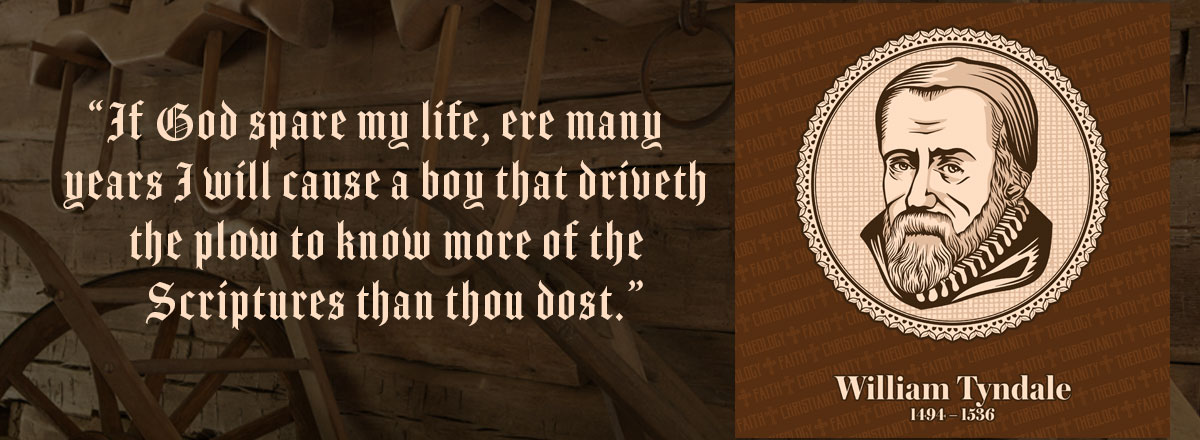
In about 1521 a young Gloucestershire priest sat at the table of Sir John Walsh at Little Sodbury Manor, where the conversation turned, as it often did, to Luther and Erasmus. Pressed hard in argument, one learned guest burst out that we were better to be without God’s laws than the pope’s. Tyndale answered him:
I defy the pope, and all his laws—and if God spare my life, ere many years I will cause a boy that driveth the plow to know more of the Scripture than thou dost.1 William Tyndale
It was not a wish. Erasmus had wished—that the farmer might sing Scripture at the plow and the weaver hum it at his shuttle—and then declared that he would rather be a spectator than an actor in the drama of the Reformation.2 Tyndale said I will. He walked onto the stage and never left it.
The law stood squarely against him. The Constitutions of Oxford, issued by Archbishop Arundel in 1408, forbade any man to translate any part of Scripture into English on his own authority, or to read such a book, unless a bishop had first approved it.3 Tyndale sought that approval from Cuthbert Tunstall, bishop of London, and was told the bishop had chaplains enough. His verdict on that year has never been forgotten:
I understood at the last not only that there was no room in my lord of London’s palace to translate the New Testament, but also that there was no place to do it in all England. William Tyndale
He sailed for the Continent in April 1524 and never saw England again.
The Book That Came in Bales of Cloth
The first attempt failed. A printer at Cologne had reached the middle of Matthew when the shop was raided. Tyndale took what sheets he could and fled up the Rhine to Worms, where Peter Schoeffer finished the printing early in 1526—a small octavo, roughly the size of a hymn book, some seven hundred pages of plain text without prologue or notes.4 It was the first complete New Testament ever translated into English from the Greek, and the first ever printed. Three copies survive.
Getting it home required a conspiracy, and the conspiracy ran on the cloth trade of Tyndale’s native Gloucestershire. Printed sheets crossed the North Sea hidden in bales of cloth and sealed casks, and an underground network waited at the docks of London, Norwich, and Bristol. Foxe tells of a farmer who gave a wagonload of hay for a copy of the Epistle of James.
On October 24, 1526, Bishop Tunstall preached against the translation at St. Paul’s and ordered every copy surrendered. The books were burned at Paul’s Cross a few days later. When surrender of the Bible failed, the bishops tried buying them up. Two ironies shine bright here. First, Tunstall’s agent at Antwerp in 1529 was a merchant who secretly favored Tyndale. Second, it has been said that the bishop, thinking he had God by the toe when indeed he had the devil by the fist, paid for every copy of Tyndale's translation he could find.5 Once Tyndale was told who the buyer was, he answered that two benefits would come of it: he would be brought out of debt, and the whole world would cry out upon the burning of God’s word.
The Offer of Silence
In the spring of 1531 the king tried persuasion. His agent Stephen Vaughan met Tyndale secretly outside Antwerp and pressed him to come home. Vaughan reported that the exile was deeply moved, so that water stood in his eyes, and then made this offer:
If it would stand with the king’s most gracious pleasure to grant only a bare text of the scripture to be put forth among his people . . . be it of the translation of what person soever shall please his majesty, I shall immediately make faithful promise never to write more . . . offering my body to suffer what pain or torture, yea, what death his grace will, so this be obtained.6 William Tyndale
He did not ask that his own translation be authorized. It wasn't about him. He would have delighted to see any accurate translate serve his country. He did not ask for safety. Instead, he offered his body to torture and death. He asked one thing only: that England should have the Scriptures and in exchange he offered to be silent forever.
The king refused. Five years later the executioner silenced him instead. And within a year of that, the king granted what Tyndale had asked.
A Lamp and a Hebrew Grammar
Betrayed by a man he had befriended, Tyndale was seized about May 21, 1535, and held some sixteen months in the castle of Vilvoorde outside Brussels. One document from that imprisonment survives in his own hand, a short letter in Latin that lay unread in the archives of Brabant for three centuries. He asks for a warmer cap, for he suffers greatly from cold in the head; a warmer coat, for his is very thin; cloth to patch his leggings; a lamp in the evening, for it is wearisome sitting alone in the dark. And then, above all of it:
But most of all I beg and beseech your clemency to be urgent with the commissary, that he will kindly permit me to have the Hebrew bible, Hebrew grammar, and Hebrew dictionary, that I may pass the time in that study.7 William Tyndale
We do not know whether he received any of it. Early in October 1536—tradition keeps the sixth—he was tied to the stake at Vilvoorde, strangled, and burned, crying out with a fervent zeal and a loud voice,
Lord, open the king of England’s eyes! William Tyndale
Within one year, Henry VIII had licensed Tyndale's translation (with completions arranged by Miles Coverdale). Within three, he had ordered that this English Bible, complete with fresh revisions, be set up in every parish church in the realm. When King James’s translators finished their work in 1611, they were in the main revising Tyndale.
They burned the book. They burned the man. Neither fire accomplished anything. The Word of God is not bound.
When Scripture is unsilenced, reform results.
Five Hundred Years On
The plowboy has his Bible now. He has it in a dozen translations, on a device in his pocket, at no cost and no risk. Tyndale offered his body to torture and death for a bare text in English. We have everything he asked for and more. The question this anniversary puts to us is not whether we admire the man who died for the book, but whether we open it with gratitude and gladness of heart.
Back William Tyndale Timeline Travels
Sources
- John Foxe, Acts and Monuments, quoted in David Daniell, William Tyndale: A Biography (New Haven, CT: Yale University Press, 2001), 79. Spelling modernized. ↩
- Desiderius Erasmus, Paraclesis; and Erasmus’s remark of 1520, both quoted in Timothy George, Theology of the Reformers (Nashville, TN: B&H Publishing Group, 2013), chap. 7. ↩
- Constitutions of Oxford (1408), in Daniell, William Tyndale, 57. ↩
- Daniell, William Tyndale, 134. ↩
- Edward Hall, Chronicle, quoted in Daniell, William Tyndale, 197; J. F. Mozley, William Tyndale (London: SPCK, 1937), 147–148. ↩
- Stephen Vaughan to Thomas Cromwell, May 20, 1531, in Daniell, William Tyndale, 216–217. Spelling lightly modernized. ↩
- William Tyndale to the governor of Vilvoorde, c. September 1535, translated by Mozley, in Daniell, William Tyndale, 379. ↩