Free or Fettered?
Discussions of predestination often begin with the human will. We experience ourselves making real choices, Scripture commands us to choose what is right, and God holds us responsible for what we do. Yet Scripture also presents God as sovereign over his creation, including the plans and actions of human beings. The question, then, is not whether people choose, but what kind of freedom those choices possess and how human willing relates to the will of God.
The apparent conflict
The Bible speaks plainly about willing human action. Israel must choose whom it will serve (Joshua 24:15). Jerusalem is condemned because its people were unwilling to come to Christ (Matthew 23:37). Christian service should be offered willingly rather than under compulsion (1 Peter 5:2). These commands and judgments would be meaningless if human choices were unreal.
The Bible speaks just as plainly about God’s rule. He does all that he pleases (Psalm 115:3), works all things according to the counsel of his will (Ephesians 1:11), and establishes the steps that people plan (Proverbs 16:9). Scripture therefore gives us no permission to preserve human choice by weakening divine sovereignty, or to defend divine sovereignty by denying human agency.
Four ways of understanding freedom
| View | Basic Claim | Central Difficulty |
|---|---|---|
| Fatalism | Outcomes follow from an impersonal necessity, making deliberation and action finally irrelevant. | It empties human choice of meaning and differs fundamentally from personal, purposeful providence. |
| Indeterminism | A free choice is wholly undetermined by prior causes, character, or governing purpose. | An uncaused choice risks becoming arbitrary rather than an intelligible act of a person. |
| Libertarian Freedom | A person is free only if, under the same conditions, he possesses the power to choose otherwise. | This makes alternative possibilities essential to responsibility and difficult to reconcile with exhaustive divine foreknowledge and foreordination. |
| Compatibilism | A person acts freely when he acts voluntarily according to his own desires, without external coercion. | It must explain how God can govern an action without becoming the author of the creature’s sinful intention. |
The Reformed understanding is compatibilist, sometimes described as free agency or voluntarism. Freedom does not mean independence from God, from our nature, or from every cause. It means that our choices truly belong to us: we act from our own judgments, affections, motives, and desires. God’s sovereign purpose and voluntary human action can therefore be true at the same time.
The will chooses according to the heart
The deepest limitation on the fallen will is not mechanical compulsion but moral corruption. Sin reaches the mind, affections, conscience, body, and will. Total depravity does not mean that every person is as wicked as possible. It means that no part of the person remains untouched by sin and that no sinner can repair his own condition.
Jesus describes the one who practices sin as a slave to sin (John 8:34). Paul says that the mind set on the flesh does not submit to God and cannot do so (Romans 8:7–8), while the natural person does not accept the things of the Spirit (1 Corinthians 2:14). Fallen people still reason, desire, decide, and act. Their will remains active, but it does not stand morally neutral before God. We choose according to what we love, and apart from grace our love of self eclipses our love of God.
This is the difference between natural ability and moral ability. A sinner possesses the faculties needed to hear the gospel, consider its claims, and make choices. What he lacks is a heart that sees Christ as supremely desirable. His inability is real precisely because his aversion to God is real.
God’s sovereignty does not erase human agency
Proverbs 16:9 places the two truths together: “The heart of man plans his way, but the LORD establishes his steps.” The human plan is genuine, and the Lord’s government is decisive. God does not compete with the creature as though greater divine action required less human action. His providence works in and through the real choices of his creatures.
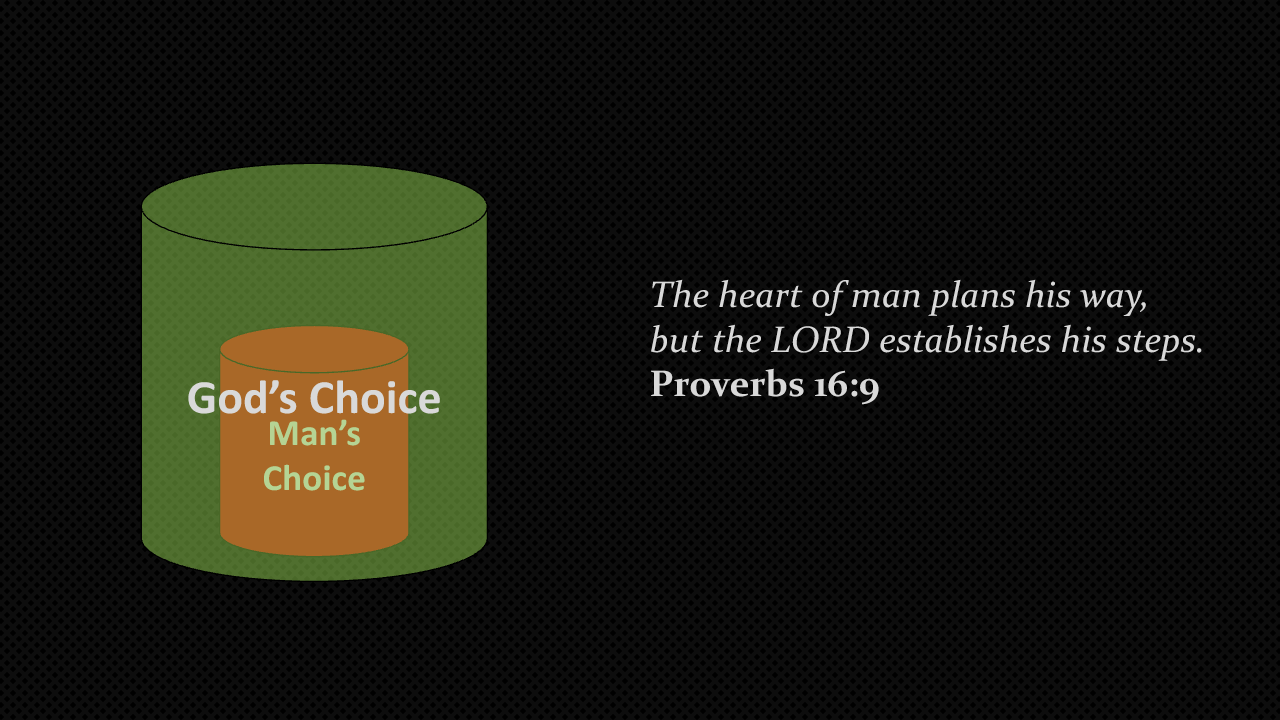
Joseph gives a clear example. His brothers acted from envy and intended evil, while God intended the same event for good in order to preserve life (Genesis 50:20). Assyria served as the instrument of God’s judgment, yet God condemned its king for his arrogance and destructive purpose (Isaiah 10:5–15). Most decisively, lawless men crucified Christ by their own wicked hands, while fulfilling God’s definite plan (Acts 2:23; 4:27–28). In each case, divine purpose establishes the event without cleansing the creature’s evil motive or turning the human agent into a machine.
Why inability does not remove responsibility
Scripture grounds moral obligation in God’s righteous authority, not in a sinner’s power to obey. What God commands remains right even when a corrupt heart refuses it. Inability does not excuse sin when that inability consists in a settled unwillingness to love what is good. We remain accountable because our actions express what we want, approve, and intend.
This also explains why divine sovereignty does not excuse evil. The creature does not sin reluctantly under external compulsion. He pursues his own purpose and therefore owns the moral character of his act. God may ordain, limit, direct, and overrule that act for a righteous end without sharing the creature’s sinful desire.
Grace frees the will by renewing the heart
Salvation requires more than new information or a fresh opportunity. God must give a new heart (Ezekiel 36:26). The Father draws sinners to the Son (John 6:44), and God makes alive those who were dead in trespasses (Ephesians 2:1–5). Regeneration does not drag an unwilling person into Christ. It changes the heart so that the sinner sees Christ’s worth and comes willingly.
Grace does not destroy human willing; it restores it. The renewed person truly believes, repents, obeys, and perseveres, while confessing that God works in him “both to will and to work for his good pleasure” (Philippians 2:12–13). Perfect freedom will come in glory, when the redeemed will no longer desire sin. The inability to sin will not diminish their freedom but complete it.
God ordains both ends and means
Compatibilism leaves no room for passivity. God accomplishes his purposes through appointed means. Prayer matters because God uses prayer. Evangelism matters because God uses the proclamation of the gospel to call sinners to Christ. Obedience matters because God brings his work to completion through the willing actions of his people. Paul continued preaching in Corinth because the Lord assured him, “I have many in this city who are my people” (Acts 18:10). Sovereignty supplied confidence for ministry rather than an excuse to neglect it.
A doctrine for humility and hope
The doctrine of the will should leave no room for boasting. If God grants life where there was spiritual death, the redeemed may glory only in him. His sovereignty also gives rest: life is not abandoned to chance, evil cannot defeat his purpose, and he will finally conform his people to Christ.
These truths must also produce humility toward Christians who understand human freedom differently. Theological clarity never justifies pride. No one is saved by mastering the mechanics of salvation, but by Christ and him crucified. To speak of a great and sovereign God with arrogance is to contradict the doctrine we claim to defend.
The freedom we need is not independence from God, but a heart made willing to delight in him.
The sum of salvation in Christ is God’s prevailing love. He does not merely place life within reach of the spiritually dead. He makes them alive, draws them willingly to his Son, and promises a future in which their wills shall never again turn from what is perfectly good.