
Roman Catholic Salvation
A sacramental process that may be lost and regained · or a gift received by faith alone · the question on which the Reformation stood.
Beneath every dispute of the sixteenth century lay one question: how is a sinner made right with God? Calvin, answering Cardinal Sadoleto in 1539, called justification by faith “the first and keenest subject of controversy between us,” and explained why it could not be yielded: “Wherever the knowledge of it is taken away, the glory of Christ is extinguished, religion abolished, the Church destroyed, and the hope of salvation utterly overthrown.”
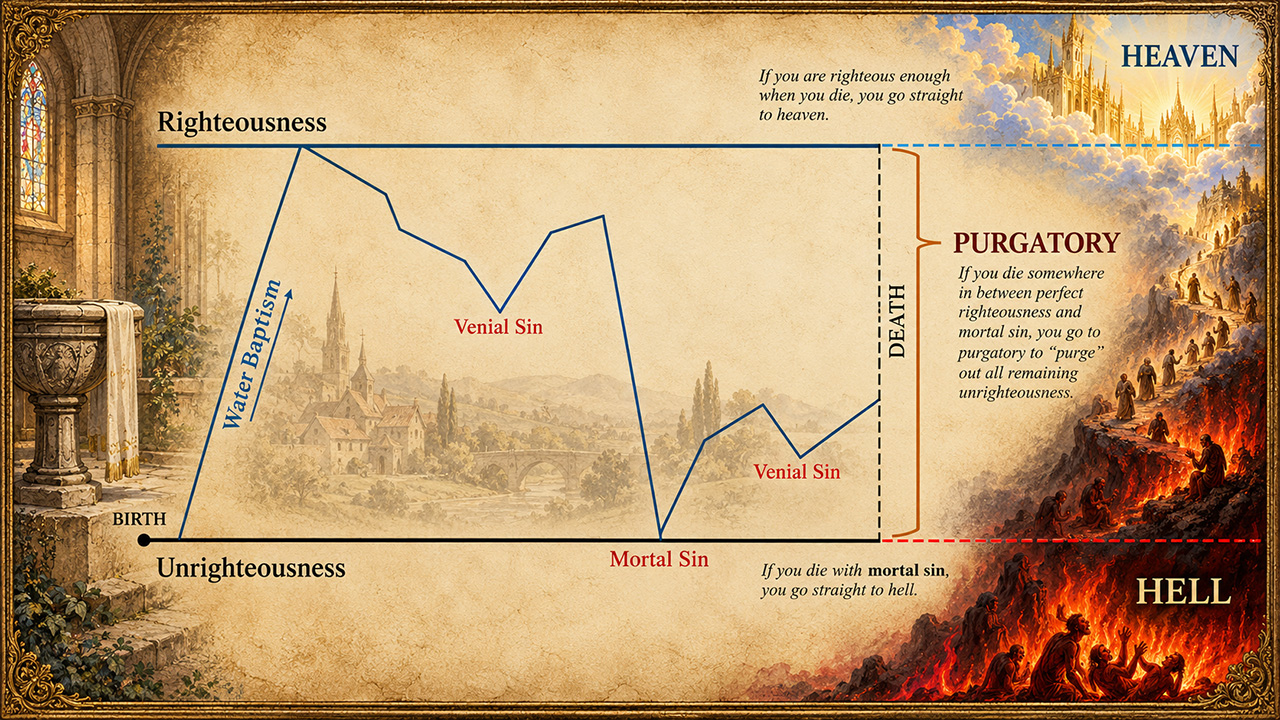
Rome’s Way
The chart traces the path Rome sets before every soul. It begins at baptism, which Rome holds “necessary for salvation” (CCC 1257): “By Baptism all sins are forgiven, original sin and all personal sins, as well as all punishment for sin” (CCC 1263). From that height the line falls and rises. Venial sin wounds charity without destroying it, but mortal sin “results in the loss of charity and the privation of sanctifying grace” (CCC 1855, 1861). The fallen may recover through the sacrament of penance, “the second plank [of salvation] after the shipwreck which is the loss of grace” (CCC 1446), and the faithful, moved by grace, “can merit for ourselves and for others all the graces needed to attain eternal life” (CCC 2027).
Where the line stands at death decides the outcome. Those who die in grace “but still imperfectly purified” must pass through purgatory “so as to achieve the holiness necessary to enter the joy of heaven” (CCC 1030). Those who die “in a state of mortal sin descend into hell” (CCC 1035). And no one may know in this life where his own line will end, for Trent taught that “no one can know with a certainty of faith … that he has obtained the grace of God” (Session 6, chapter 9). The same council closed the door on the alternative:
If any one shall say, that by faith alone the impious is justified; so as to mean that nothing else is required to co-operate in order unto the obtaining the grace of justification … let him be anathema.
Council of Trent, Session 6, Canon 9
The Reformers’ Answer
The Reformers answered with one voice. Luther wrote in the Smalcald Articles that because justification in Christ “cannot be otherwise acquired or apprehended by any work, law, or merit, it is clear and certain that this faith alone justifies us,” and then drew his line in the sand: “Of this article nothing can be yielded or surrendered … even though heaven and earth, and whatever will not abide, should sink to ruin.”
Zwingli opened the Reformation in Zurich with his Sixty-Seven Articles: “Christ is the only way to salvation for all who were, who are, and who shall be. Whosoever seeks or shows another door, errs.” Of works he wrote simply, “Christ is our righteousness.” Tyndale, in his Pathway into the Holy Scripture, taught the plowboy the same gospel: “though faith is never without love and good works, yet our salvation is not imputed to love or good works, but to faith only.” And Knox, in his Vindication That the Mass Is Idolatry, condemned the trust of any man “whose heart believed remission of sins by a vain work.”
The Word of God
The Reformers did not invent this answer. They found it in Scripture. “Therefore we conclude that a man is justified by faith without the deeds of the law” (Romans 3:28). “For by grace are ye saved through faith; and that not of yourselves: it is the gift of God: not of works, lest any man should boast” (Ephesians 2:8–9). Rome’s chart is a jagged line that rises and falls to the hour of death. The gospel draws a different line: “He that heareth my word, and believeth on him that sent me, hath everlasting life, and shall not come into condemnation; but is passed from death unto life” (John 5:24). For “by one offering he hath perfected for ever them that are sanctified” (Hebrews 10:14).
For each point of Rome’s teaching set beside the Scripture that answers it, see the Salvation Comparison Table.
Related on This Site
Sources
- Catechism of the Catholic Church, 2nd ed. (Vatican City: Libreria Editrice Vaticana, 1997), 1030, 1035, 1257, 1263, 1446, 1855, 1861, 2027.
- Theodore Alois Buckley, trans., The Canons and Decrees of the Council of Trent (London: Routledge, 1851), Session 6, chapter 9 and Canon 9.
- John Calvin, Reply by Calvin to Cardinal Sadolet’s Letter (1539), in Tracts Relating to the Reformation, trans. Henry Beveridge, vol. 1 (Edinburgh: Calvin Translation Society, 1844).
- John Knox, A Vindication That the Mass Is Idolatry, quoted in Christian History, “John Knox & the Scottish Reformation.”
- Martin Luther, The Smalcald Articles (1537), Part II, Article I, trans. F. Bente and W. H. T. Dau, in Triglot Concordia (St. Louis: Concordia, 1921).
- William Tyndale, A Pathway into the Holy Scripture (c. 1530).
- Ulrich Zwingli, The Sixty-Seven Articles (1523).
