
The Great Schism of the Papacy
For nearly forty years, the Western church was divided over who was pope. Two men, and later three, maintained courts, appointed clergy, and demanded obedience from the same church. The crisis arose from a disputed election in 1378, endured because rival claimants and their supporters would not yield, and ended with Martin V’s election at the Council of Constance in 1417. It tested claims about papal authority and exposed how deeply church government had become entangled with the politics of European kingdoms.1
From Avignon to Two Popes
Since 1309 the papal court had resided in Avignon, where proximity to French power fostered doubts about its independence. Gregory XI returned the court to Rome in 1377 but died the next March. Roman crowds feared that a French successor would take it back to Avignon. Under that pressure, the cardinals elected the Italian Urban VI in April 1378. Urban’s severe treatment of the cardinals soon alienated many of them. They then argued that intimidation had invalidated the election and chose Clement VII in September. Clement eventually established his court at Avignon. Gregory XI thus belongs to the background of the schism; he died before the rival elections.2
Neither claimant could command all of Western Christendom. France, Castile, and Scotland generally supported Clement; England and much of the German Empire supported Urban. The rivalries of the Hundred Years’ War reinforced these choices. Cardinals, rulers, and clergy also had interests in the appointments, revenues, and judgments issued by each court. Each obedience claimed to preserve the church’s unity while rejecting the other’s authority. In practice, competing bishops and papal officers, disputed benefices, and rival excommunications divided the very institutions meant to serve one church.3
Francis Oakley describes the result:
widespread administrative confusion and jurisdictional conflict, as well as a mounting and debilitating spiritual anxiety. Francis Oakley“The Great Papal Schism”4
The Rival Lines
New elections perpetuated the division. The principal claimants were:5
- Roman line: Urban VI (1378–1389), Boniface IX (1389–1404), Innocent VII (1404–1406), and Gregory XII (1406–1415).
- Avignon line: Clement VII (1378–1394) and Benedict XIII (1394–1417).
- Pisan line: Alexander V (1409–1410) and John XXIII (1410–1415).
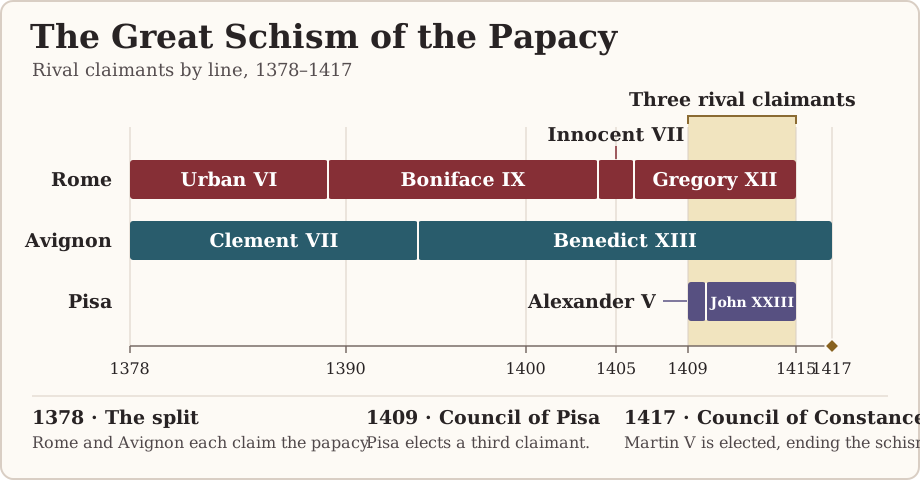
The last Roman claimant was Gregory XII, not Gregory VII, who lived in the eleventh century. Alexander V and John XXIII were elected by the council at Pisa; Martin V was elected later at Constance to reunite the obediences. In the Roman Catholic Church’s present reckoning, the Roman line is recognized as legitimate and the Avignon and Pisan claimants as antipopes. Those labels did not settle the question for the people who lived through it.6
Pisa Makes Three
As decades passed, proposals for mutual resignation or negotiation came to nothing. Cardinals from both obediences convened the Council of Pisa in 1409, pronounced Gregory XII and Benedict XIII deposed, and elected Alexander V. Neither existing claimant accepted its verdict. After Alexander died in 1410, the Pisan cardinals elected John XXIII. A council called to end a twofold schism had produced three simultaneous claimants. The failure raised an unavoidable question: who could summon a council or judge a pope when the identity of the lawful pope was itself disputed?7
Constance and the Question of Authority
Under pressure from King Sigismund, John XXIII summoned the Council of Constance, which opened in 1414. John fled when the council moved against him and was deposed in 1415. Gregory XII authorized the assembly through his representatives and resigned on July 4, 1415. Benedict XIII refused to yield and was deposed in July 1417. On November 11 the council elected Martin V, ending the division of the Latin church into rival obediences.8
To act despite a claimant’s resistance, Constance made this claim in Haec Sancta (1415) about a general council representing the church:
has its power immediately from Christ Council of ConstanceHaec Sancta, April 6, 14159
The decree went on to say that even a pope was bound to obey such a council in matters of faith, healing the schism, and reform. The council’s Frequens (1417) called for future general councils at regular intervals. This conciliar answer curbed claims of unchecked papal rule in a time of emergency. Its continuing force was contested, and later popes resisted the council movement’s broader program of reform. Constance restored a single recognized pope without resolving every dispute about where final authority in the church lay.10
Wycliffe and Hus
John Wycliffe was already disputing papal claims to wealth and temporal power before the schism began. The rival elections gave new force to his question about whether any pope could be identified simply with the church’s true head. He pressed instead for Christ’s headship and the authority of Scripture. The schism did not create his theology, but it exposed the weakness of a church order that demanded one visible head while presenting two competing claimants. Wycliffe died in 1384; Constance condemned his writings decades later, in May 1415.11
Jan Hus learned from Wycliffe’s writings, though he did not adopt every one of Wycliffe’s teachings. Papal politics reached Prague directly: the University of Prague divided over which claimant to recognize, and John XXIII authorized indulgences to finance a campaign against a supporter of his Roman rival. Hus opposed the sale. In On the Church (1413), he defined the church this way:
But the holy catholic—that is, universal—church is the totality of the predestinate or all the predestinate present, past, and future. Jan HusOn the Church, chapter 112
His claim placed Christ and his people above any one ecclesiastical office. Despite a promise of safe conduct, Hus was arrested at Constance. The council, which sought reform “in head and members,” condemned him for heresy and handed him over for execution on July 6, 1415. It could challenge rival papal claims while refusing Hus’s deeper challenge to the church’s structure and teaching.13
What the Schism Revealed
The settlement at Constance ended the immediate contest, but it did not erase the damage. Rival claimants had asserted universal authority while dividing the church and condemning one another. Pisa had multiplied the problem it meant to solve. Constance called for reform and restored unity, yet suppressed Hus and left many abuses in place. The schism exposed the vulnerability of papal claims to political allegiance and sharpened the question of whether pope, council, or Scripture could finally bind the conscience. Wycliffe and Hus answered that question by turning to Christ and his Word, a concern that would reappear in the Reformation a century later.14